Boating design shifts toward safety and usability as sail-to-power buyers reshape demand, says RBS Marine
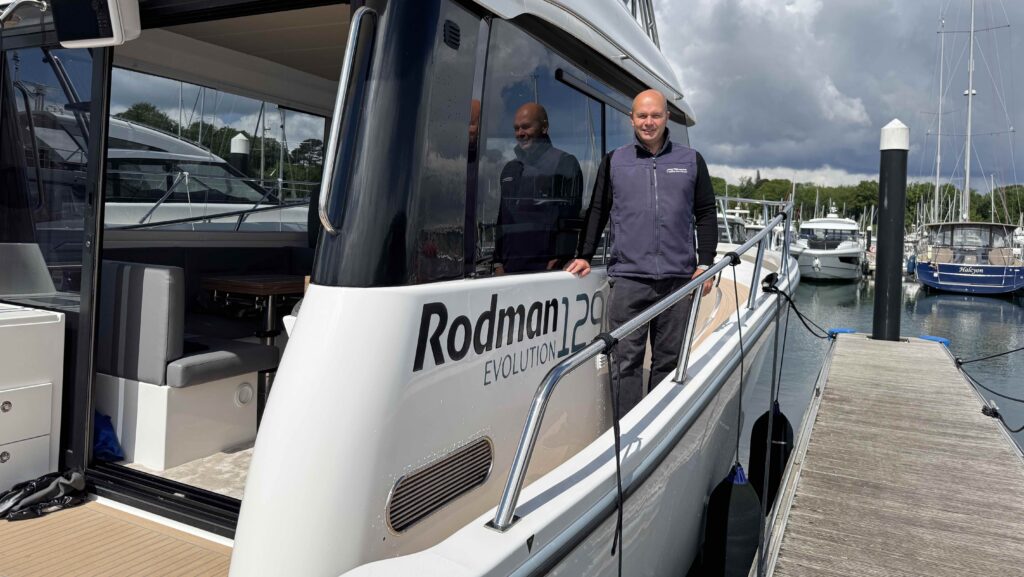 Ben Stevens, MD RBS Marine
UK motorboat demand is being reshaped by a stronger focus on safety, onboard movement and ease of handling, particularly among owners transitioning from sailing, according to RBS Marine.
It’s mainly because of practicality, says Ben Stevens, company director at RBS Marine. “People coming to power want the safety of being able to walk around.”
The Rodman range, which originates from Spain and is built in Vigo in northern Spain, is being positioned around practical offshore capability and walkaround usability, with demand increasingly influenced by sail-to-power transitions and later-life ownership requirements.
Revamped platform design built on established hull performance
Stevens (speaking from the British Motor Yacht Show in Premier Marina’s Swanwick location) highlights that the Rodman 1290 is a revamp of the Rodman 1250 platform, with the original hull retained due to its established sea-keeping performance. (Details are available on the company’s website.)
Stevens says this reflects continuity in core design rather than a complete redesign, with the focus on updating layouts and usability while maintaining proven offshore characteristics.
Rodman’s commercial manufacturing background also allows for a higher degree of specification flexibility compared with higher-volume production builders.
“Their commercial background enables them to build bespoke finishes as well, so we can tailor a lot of the boats to people’s requirements,” he says.
Customer shift driven by sail-to-power transition and single-handed use
Alongside platform development, RBS Marine reports a clear shift in customer profile, with increasing numbers of buyers moving from sailing into motorboats and prioritising ease of movement, safety and simplified handling.
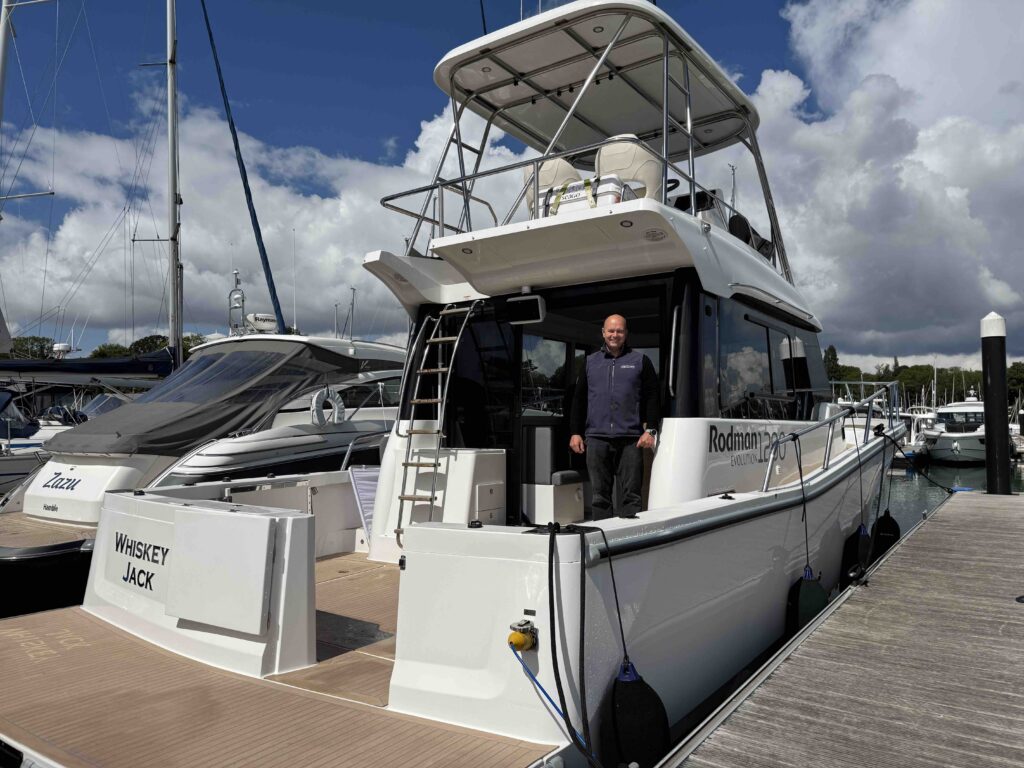
The layout of boats such as the Rodman 1290 is being positioned to support single-handed operation and reduced onboard complexity, with features including a side access door and helm controls designed to improve usability when operating alone.
The trend is also linked to later-life ownership, where buyers are drawn to reduced physical demands and easier circulation around the vessel.
Operating model: low stock, demo-led distribution and owner network support
RBS Marine operates with minimal stock holding, relying instead on short manufacturer lead times and access to customer-owned vessels and demonstration boats.
Lead times are typically around three to six to seven months, supported by Rodman’s partial build process, where hulls are already in production before completion and configuration.
Stevens says this reduces the need for holding inventory: “Because of the shorter lead times we don’t really need to hold stock so much.”
The business also draws on a wider owner network to support demonstrations and boat show participation, reducing capital exposure while maintaining product visibility in the market.
Broader uses include cruising and emerging UK fishing activity
The vessels are being used across a range of applications including leisure cruising and offshore activity, with emerging demand linked to bluefin tuna fishing in the UK.
Stevens notes charter activity in the south west of the UK, including Falmouth, where vessels are being used for licensed fishing operations.
Wide side decks and stable hull design are supporting this multi-role usage, combining cruising capability with specialist fishing applications.
Harder macro tension: demand remains but conversion to orders is slowing
Despite continued interest, RBS Marine reports a softer environment for new boat orders, following a stronger start to the year.
“We started off January, February very well and now things have dropped again,” says Stevens. “I think probably the cost of fuel… and I think the boating industry is feeling the pinch now.”
The key issue, he adds, is not a lack of interest but wider economic uncertainty. Buyers are delaying decisions.
“We’d like to see people getting orders in for either later this year or into the following year,” he says, and notes that brokerage activity remains more resilient than new boat sales.
Outlook for 2026 and beyond
Stevens says that the sector continues to operate in a cautious trading environment, shaped by fuel costs, consumer confidence and broader economic pressures. While underlying demand for practical, seaworthy motorboats remains stable, RBS Marine says forward order placement and improved market confidence will be key to stabilising dealer pipelines and production planning.
The company is planning to attend the Southampton International Boat Show – it’s an important part of maintaining momentum in a cautious market.
“We all need to be in it together to make a show of it,” he says, suggesting that despite current economic pressures, there remains a shared industry responsibility to support events that help sustain buyer interest and keep the sector connected.