The bolt-on hydrofoils that could transform 100,000 boats a year
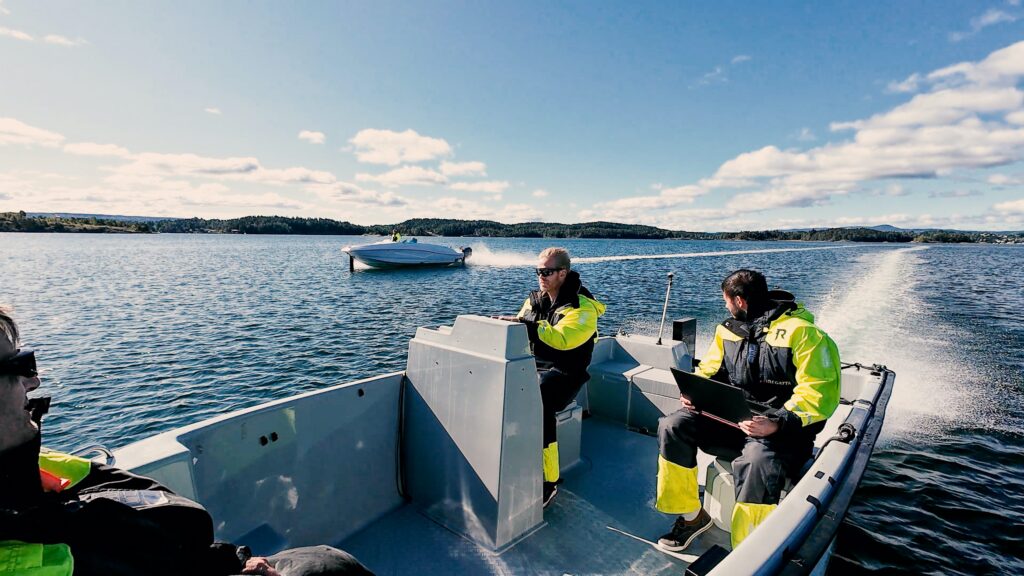 Lift Ocean’s team tests its retractable, bolt-on hydrofoil system
MIN sits down with Norwegian Olympic sailor – and now CEO of Lift Ocean Marine – Petter Mørland Pedersen to discuss his company’s latest pivot, which aims to “unlock a huge market” with retractable, bolt-on hydrofoils.
Lift Ocean is a small company with four employees, located 15 minutes from downtown Oslo and funded by private investment. At its waterfront offices, it’s testing and developing a standard bolt-on hydrofoil system. This is a pivot – four years ago, the company started out with custom hydrofoil projects. Now, it’s focused on delivering a generic hydrofoil kit to the boat manufacturers. “Similar to how a boat manufacturer buys an outboard engine, a windshield or a navigation system,” says Mørland Pedersen.
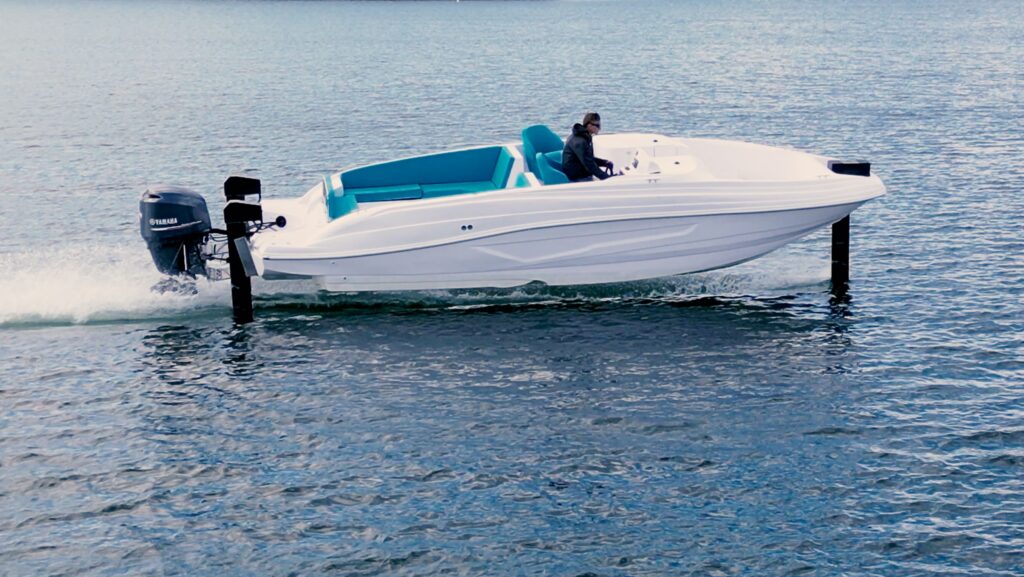
The system, which he describes as simple, features retractable foils that allow the boat to be used as ‘normal’ when needed.
“Our system is bolted on, and then it is up to the boat manufacturer how they want to integrate it, either build the boat around it, or simply add it to the boat,” Mørland Pedersen continues.
The system is designed to work across a broad range of hull shapes, provided the vessel can achieve take-off speed (typically 15-18 knots) and falls within the relevant weight and geometry envelope. (The foils are designed for boats in the range 1-3 ton, however, this is possible to further optimise for a specific model, if required.)

“It is bolted onto the hull (front and back), potentially with an adapter to cater for angles. For the stern foils, the system is literally bolted on through the stern of the boat.”
The stern of the boat typically has sufficient structural strength to take the hydrofoil system due to the outboard engine installation, he argues. There is also usually suitable structural strength in the bow and forward bulkhead area. Some modifications will normally be required, and these will vary from boat to boat.
“For the front, it is up to the boat manufacturer how they want to integrate it. But we need a mounting surface to bolt our box to. For one of our demo boats, the boat manufacturer has prepared a simple slot or cassette in the bow, where our box is bolted on inside.”
And when the foils are bolted in place, the “boat will be trailable with a conventional trailer,” he adds. This is possible because the foils are retractable. Other benefits of retractability include enabling on-water inspection, cleaning and service, and no marine growth when at rest.
“With the foils retracted, you will have the struts coming out of the deck. However, they are away from any social or work zones, so they are not affecting normal operation or usage.”
And if anything “severe” happens, owners can unscrew the bolts and remove the complete system.
He explains that the boat is stabilised through an active control system that automatically adjusts the angle of the foils. This keeps the boat stable, maintains ride height and controls banked turns. The driver does not need to do anything beyond steering and throttle input, just as in a conventional boat.
A supplier model designed for boatbuilders
The idea is to work closely with boatbuilders.
“From a commercial point of view, our complete business model is different. We supply the complete system to boat manufacturers, B2B.”
Mørland Pedersen says this makes life easier for boat manufacturers who can relate to Lift Ocean in the same way they do with any other supplier.
“It is really up to the boat manufacturer how they want to integrate this into their design. This spans from customers who just bolt it on, to customers working closely with 3D CAD tools to make it an integral feature of the boat.”
How a three-day retrofit got a boat flying
A typical high-speed conventional vessel requires minimal modification to be ready for the bolt-on hydrofoil system.
Mørland Pedersen gives an example. “One of our customers [Holland Ship Yard Group] was interested in foiling technology and wanted to try it out. One alternative was to undertake an expensive, time-consuming R&D project to design a new foiling vessel. Or, call Lift Ocean. Which is what they did.”
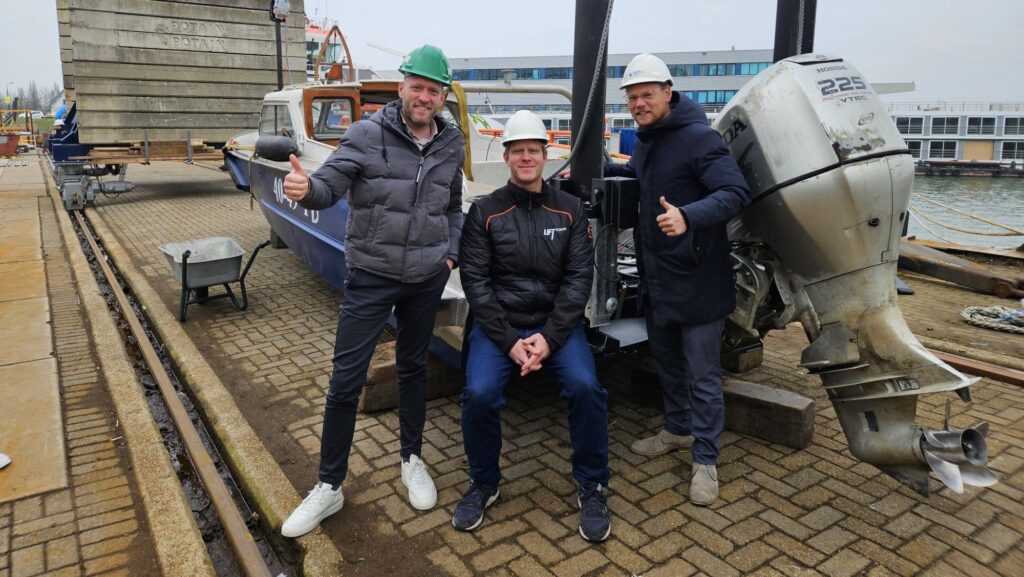
“They found an old boat they had lying around, made a few minor modifications. And it took us three days from when we arrived at the yard until their test boat was flying.
“The important message is that the minimum required effort to install the system for testing is nothing compared to buying a new foiling boat.”
The size of an untapped market
Mørland Pedersen notes that a lot of hydrofoil technology looks impressive in theory, but commercial adoption depends on practical integration. “Our focus has been to bridge that gap by designing a system that not only performs on the water, but can also be installed, controlled and maintained in a way that is realistic for boatbuilders and operators.
“We have demonstrated this by integrating our standard system on three very different boats, both in size and weight.
“The market is still at an early stage, so our focus today is less on direct competition and more on helping mature the hydrofoil market overall. There are other players in the wider foiling space, but not direct competitors.
“We believe our approach is differentiated by focusing on practical integration, conventional propulsion compatibility and a more accessible commercial model. Over time, as the market develops, competition will naturally become clearer.”
Now he is looking at the existing high-speed boat market for the bolt-on hydrofoils.
“We are targeting high-speed boats in the range of 20-50ft across market segments. In terms of applicable market size, we are talking a potential of a hundred thousand-plus per year. Including the retrofit market, you can only imagine.”
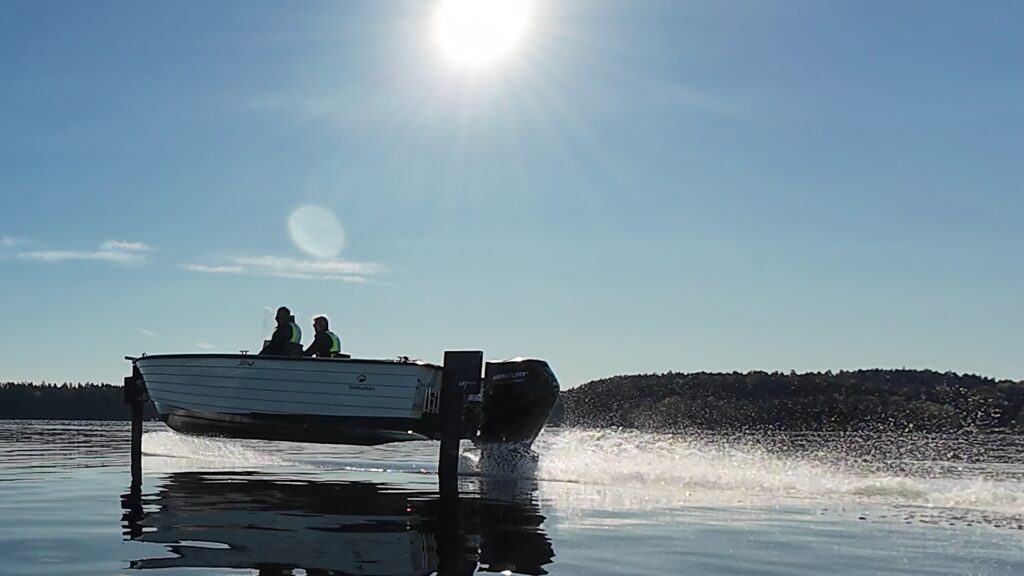
Compared to building its own bolt-on hydrofoil system, Mørland Pedersen says boat manufacturers will benefit from his volume, product development and scale. “Our product will reach a quality and cost level that no boat manufacturer could match if this were done internally.”
But there are some physical limitations. “The main factors to calculate are cruising speed, wing-span (beam of the boat) and weight. Our first system is aimed to fit a majority of conventional boats from 20-30ft, ranging from 1-3 tons.” The next product is targeted towards boats in the 30-40ft range.
Currently, Lift Ocean is working with a client in the Maldives who is planning to launch a fleet of hydrofoil water taxis. “There’s huge potential in terms of the number of boats. We will deliver the foil system and work closely with the boat manufacturer and the local operator.”
Why Lift Ocean abandoned custom projects for scale
When Mørland Pedersen first set out to build the company, he’d planned on delivering complete vessels – but one quick financial forecast later, he says the model didn’t add up.
“Too high CapEx, low volume, low scalability. The decision was simple: let boat manufacturers do what they are good at, building boats, while we deliver the hydrofoil system.”
That originally looked like making custom foils, but it was quickly apparent that while custom projects delivered experience, there was no scalability in bringing foiling to the masses.
“That’s when we decided to focus on a standardised hydrofoil system.” Using that approach meant Mørland Pedersen could reduce commercial and technical hurdles and enable boat manufacturers to get familiar with foiling and implement the technology in their businesses without breaking the bank.
“You can only imagine the cost of an outboard engine if it were custom-built for every boat. With this approach, our market and scalability potential are enormous,” he says.

Energy agnostic efficiency: electrons or dinosaurs
Now Lift Ocean is looking to sell efficiency – “whether you have electrons or dinosaurs on the tank.” He claims that the hydrofoil system does not require more energy than a standard outboard engine.
“We have to be energy agnostic and let our customers figure out the best energy source for their application.
“Today, electric propulsion for high-speed vessels is still a quite narrow niche, and until this is wide-spread, why not increase the efficiency for conventional propulsion? It’s good for the environment and the wallet.”
Currently the system comes with standard foils with a wingspan of 115cm. (But the foils can be easily be swapped out and upgraded for a specific model.) The system’s been tested on three different boats ranging from 17 to 28-feet and from 1000 to 2800kg. Orders placed within Q1, will be delivered by end of 2026.
“The system is designed to, and has demonstrated to, sustain full-foiling operation when in foiling mode, subject to vessel setup and operating conditions. We have observed no hull damage in testing, and none is anticipated when the system is installed as specified.”
Hydrofoil context
Most hydrofoil innovation happens in integrated boat designs, not bolt-on kits. Until now, retrofit foils are mostly limited to pontoon boats, small powerboats, or specialist custom engineering projects.
Typically hydrofoil startups build entire vessels, not retrofit kits, because foils require reinforcement in the hull, active stabilisation software is often needed and the foil geometry needs to be compatible with the hull shape.
But by removing the cost, risk and complexity of designing fully foiling vessels, Lift Ocean Marine is betting it can quietly build one inside the boats already being made. If Mørland Pedersen is right, the future of foiling won’t arrive through futuristic prototypes – but through a set of bolts, a standardised kit, and boat builders ready to fly without starting from scratch.