
Connected technology reshapes marine equipment manufacturing
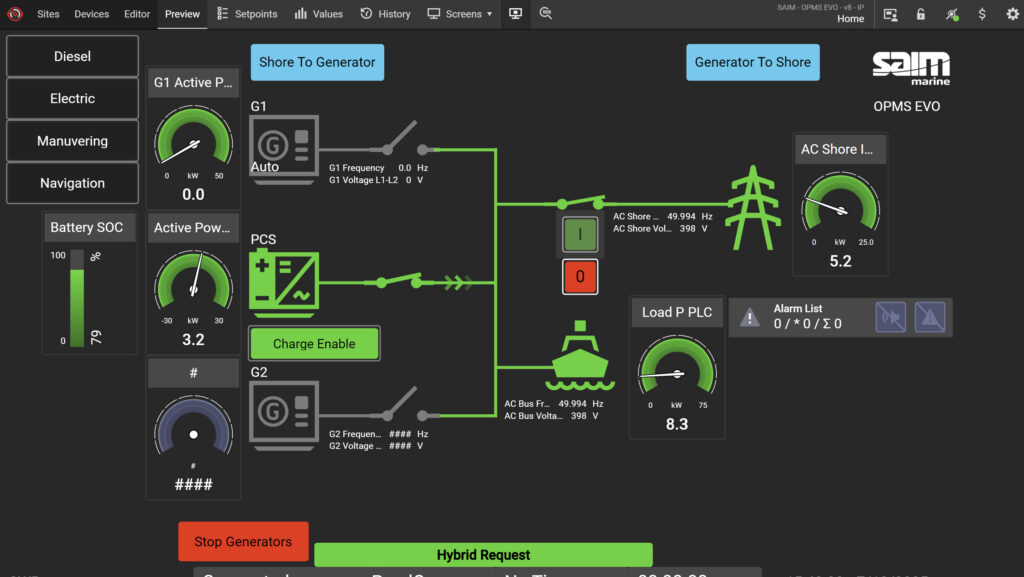 Saim OPMS schema
Onboard equipment can no longer operate in isolation. The connected boat has been in development for quite some time and now the commercial value of marine equipment is increasingly determined by its ability to operate within a connected environment.
But what has that meant for manufacturers who’ve had to move their products into integrated experiences? In the run up to Metstrade, MIN sits down with four manufacturers to talk interoperability, resource allocation and commercial models.
Data are power
Over the past few years, manufacturers have moved beyond selling individual pieces of equipment. They’re now taking responsibility for how their products communicate, share information and operate as part of a wider vessel.
Actisense is connecting data. Fischer Panda is bringing complex power systems together. ePropulsion is moving towards integrated propulsion and energy management, and Saim is using data to improve power management, vessel efficiency and aftersales.
They all demonstrate that the value of a piece of marine equipment increasingly depends on how well it works with everything else onboard. And those that demonstrate their software, integration and ongoing services are ahead of the game have a key differentiator.
“The physical equipment remains essential, but its value increasingly depends on how effectively the complete system works together for the boatbuilder and owner,” notes Danny Tao (ePropulsion).
“As systems become more connected, interoperability, clear system architecture and the ability to support the installation as a whole become increasingly important alongside the performance of individual products,” says Chris Fower (Fischer Panda UK).
Interoperability: a key selling point
The premise behind any development on a boat is to make life onboard straightforward. Customers want less complexity and accessible information without having to understand the technical architecture.
“For us, this evolution is not about adding technology for its own sake. It is about bringing the right equipment together and making it easier to specify, operate and support as a complete system,” continues Fower.
Interoperability is now a critical selling point. Under consideration is whether a manufacturer’s system integrates with the rest of the vessel, whether information can be shared with third-party displays and applications, and if future upgrades will introduce compatibility problems.
“The ability to communicate with other technologies is now as important as product reliability itself,” argues Marco Donà (Saim).
Manufacturers invest in software skills and resources
For manufacturers, moving into software is not simply a product-development decision. It’s about increased investment in skills, resources and R&D.
Justin Cohen (Actisense) says: “While we are at heart an equipment manufacturer, more and more of our team resource is being allocated to focusing on the user experience including firmware, web-apps and cloud-based systems.”
Fischer Panda says digital literacy, data handling and collaboration with technology partners are becoming increasingly valuable skills, and Saim has even established an in-house R&D department covering software development, electronics and digital technologies.
“This approach allows us to respond quickly to technological advances and transform them into practical solutions for our customers,” notes Donà.
Connected services could reshape aftersales economics
As connected technology becomes de rigueur, it’s likely to keep changing the economics, and delivery, of aftersales and technical support.
Saim is developing value-added services through monitoring, diagnostics and dealer support.
“Historically, information sharing in the marine industry relied heavily on paper documentation,” says Donà. “Today, dealers can access a dedicated portal containing the complete service history of each machine, helping to standardise processes and improve the quality and consistency of after-sales support.”
Actisense currently provides cloud functionality and lifetime firmware updates free with its hardware. “In future, there may be some additional storage and premium features we can add for a nominal fee, but there will always be this free functionality,” says Cohen.
How manufacturers make money from software and ongoing services is still developing. For example, whether connectivity will remain an added benefit of hardware sales, or whether subscription services, remote support and data-driven services become significant revenue streams.
The challenge of proprietary software
With more sophisticated proprietary software, there’s also potential tension between creating an integrated product experience and proprietary behaviour. But, as Cohen says: “While some manufacturers isolate their systems, most tend to want to interact with other instruments or sensors onboard.”
Saim explicitly argues against closed ecosystems, saying that interoperability is now as important as product reliability.
“Our objective is not to create closed ecosystems, but to empower shipyards, installers, and owners to build flexible and scalable systems in which every component contributes to more efficient and coordinated vessel management,” notes Donà.
Tomorrow (11 November 2026), MIN focuses on Actisense.








Leave a Reply