
HMRC updates guidance on superyacht fuel duty in UK waters

HM Revenue & Customs (HMRC) has issued updated guidance that aims to clarify the rules on how fuel duty applies to superyachts and their support vessels in UK waters, and makes clear when those vessels should be treated as private pleasure craft (PPC) rather than commercial operations.
The guidance, shared this month (June 2026) does not introduce new law. Instead, it sets out HMRC’s reading of the existing rules and provides Registered Dealers in Controlled Oil (RDCOs) with more guidance on supplying red diesel to marine vessels.
Clarity around fuel duty rebates and reliefs
For the industry, the newly sharpened position should help clear up some of the uncertainty that has built up around fuel duty rebates and reliefs, especially for yachts that are commercially owned or active in the charter market.
HMRC’s view is straightforward enough: what matters is how the vessel is actually being used when the fuel is supplied; not how it is owned, registered, crewed or chartered.
Under the HMRC guidance, a vessel counts as a private pleasure craft when it is being used for private or recreational purposes by an owner, charterer, hirer or another authorised user. This definition covers leisure cruising, holidays and private charters taken for enjoyment. HMRC says chartering a yacht does not, by itself, turn it into a commercial vessel for fuel-duty purposes.
Most superyachts should be treated as PPCs
For superyachts, that means most vessels in the sector – including many that are available for charter – should be treated as PPCs when bunkering in the UK. HMRC says that applies where the owner or charterer controls how the vessel is used and enjoys it for leisure, even if the yacht is professionally crewed, moving between charters, sitting on standby or otherwise supporting recreational use.
Commercial treatment is expected only in a small number of cases, such as when a vessel is hired out to provide non-recreational services for government bodies, industrial operators or similar clients in return for payment.
White diesel and red diesel
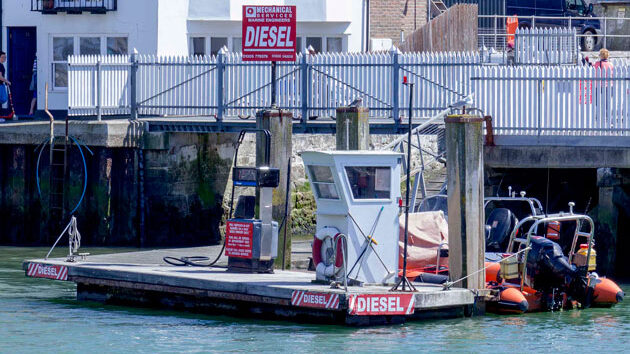
UK marine operators may come across both white diesel and red diesel. White diesel is taxed at the standard fuel duty rate and carries standard VAT treatment, with no relief available. Red diesel is the same fuel, but dyed and reserved for lower-duty uses, including certain non-propulsion marine purposes such as heating and electricity generation.
HMRC’s guidance confirms that private pleasure craft cannot use Marine Voyages Relief and cannot run on rebated red diesel for propulsion. Red diesel can still be supplied to PPCs, but the declaration must show how much is for propulsion and how much is for non-propulsion use. Fuel suppliers are then responsible for paying HMRC any extra duty due on the propulsion element. Where the fuel is used for qualifying non-propulsion purposes, the lower-duty treatment can still apply if the conditions are met.
If red diesel is supplied for propulsion on a private pleasure craft, the full duty has to be paid to HMRC. The current full duty rate is 52.95 pence per litre, and full-rate VAT applies to red diesel supplies of 2,300 litres or more.
Wide gap between duty rates
The guidance also underlines how wide the gap now is between duty rates. After changes introduced earlier this month, the rebated red diesel rate dropped from 10.18 pence per litre to 6.48 pence per litre until 31 December 2026, leaving a difference of 46.47 pence per litre compared with standard white diesel duty. For larger superyachts, that can add up quickly.
Fuel suppliers to gather more information
HMRC is also asking more of fuel suppliers. RDCOs are expected to gather declarations showing how the fuel will be used, keep records that support the vessel’s classification and challenge claims that do not seem credible. The authority says suppliers should not rely only on a customer’s description, charter status or the presence of professional crew when deciding how to treat a vessel.
If commercial use is claimed, HMRC advises suppliers to ask for a written explanation and supporting documents. It also wants suspicious supplies or declarations reported directly, with full details provided where concerns arise.
The clarification and revised guidance come after a wider industry debate over whether fuel duty reliefs had sometimes been applied incorrectly.
Read HMRC’s latest guide to supplying fuel to private pleasure craft online.