‘No legacy constraints’: How Navico plans to reinvent boating with AI

“You know the reason the likes of a Tesla or a Lucid has been successful in automotive? It’s because they don’t have any legacy constraints.” That’s according to Navico Group’s EVP & president, and Brunswick Group’s chief technology officer Aine Denari.
Denari’s very aware of constraints that can hold innovation back – the ‘that’s not how we do it’ attitude. As CTO for a behemoth of a marine group, she says disruption needs to be actively fostered and encouraged in-house, especially when there’re competitors nipping a company’s heels.
“As people say, ‘look to be the disruptors rather than the disrupted’.”
Leaps and bounds of Chinese technology is huge
Denari comes from the automotive sector, specifically autonomous driving. She’s watched China grow as a huge threat in that space.
“The leaps and bounds of Chinese suppliers is huge. We’re not seeing that in the marine space currently, but that doesn’t mean it won’t come at some point. It’s a scale question. The scale in the marine industry is a lot different than the scale in the automotive industry.”
This means marine isn’t seeing the same level of focus and attention from China, “but it doesn’t mean that we won’t ever. That’s one of the things we will continue to keep a very close eye on.”
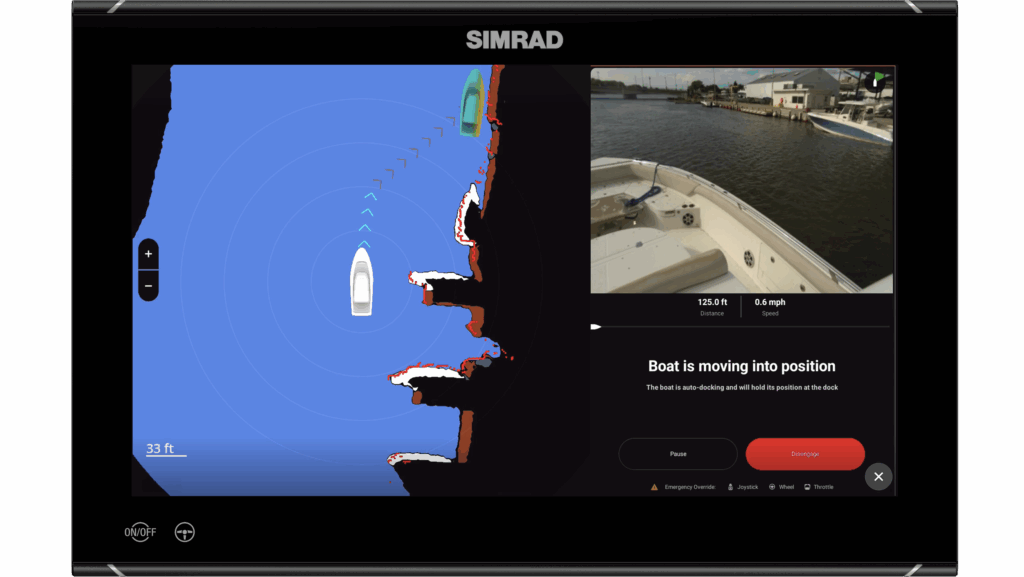
Right now Denari’s got her eye on how AutoCaptain is performing since its launch.
Navico / Simrad’s AutoCaptain (launched at IBEX) has been developed under Brunswick’s ACES strategy – which started back in 2019.
The ACES strategy is all about autonomy, connectivity, electrification, shared access and, of course, AI.
“We’re investing in the 5, 10 plus year horizon [with this],” Denari says.
One of the first solutions to be commercialised under this banner is AutoCaptain with a goal to drive more participation in the boating industry by taking away a lot of the key pain points. For many boaters those look like docking, undocking, and tight manoeuvring.
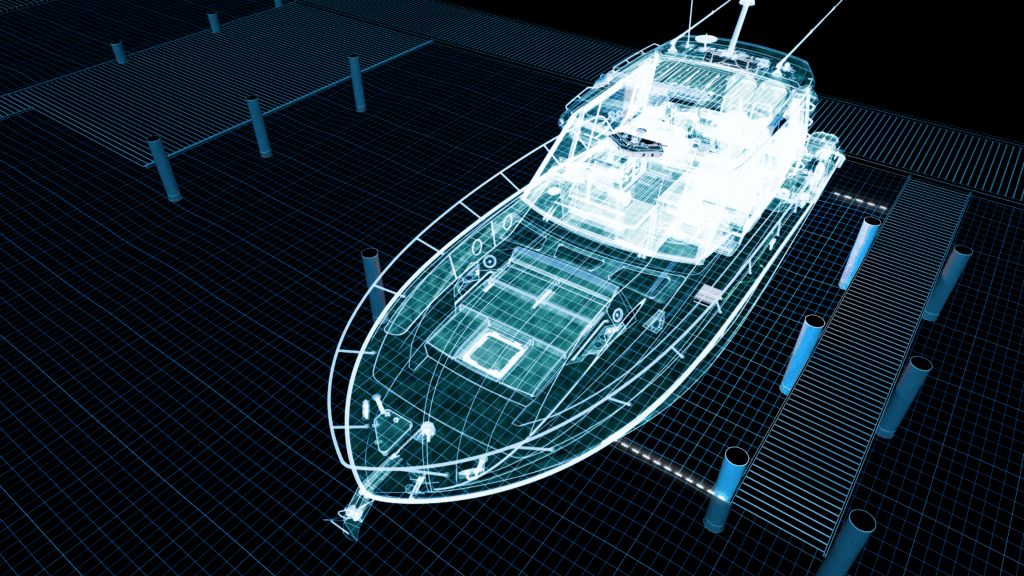
The system leverages stereo cameras offering a 360-degree view around the boat, with the idea to gain depth perception. Other situational awareness components are in play, like GPS and AIS etc.
A central module identifies what AutoCaptain is seeing around the boat – a dock, a buoy, a swimmer in the water, another boat – and on that basis plans a path to get from A to B – avoiding obstacles while sending the commands to the propulsion system. AutoCaptain also adapts in real time depending on sea state, wind, current, and obstacles that might come up in the way.
Validating the AutoCaptain system
Because the system takes control of the boat, there’s been a lot of validation throughout the process.
“The architecture needs to be functionally safe to make sure that there can’t be any cybersecurity issues and there can’t be any potential failures. There’s also built in redundancy to make sure that if one thing stops working there’s a plan to make sure everything continues to be safe.”
AI training on water, sea states and obstacles
AutoCaptain’s validated for any potential use case that might come along. Denari gives the example of Chicago. On some of the lakes in Chicago during the summer, there’s a lot of green growth on the water. The cameras are trained that while the water might be green, in this case it’s not grass, it’s still water.
As well as the broad spectrum of what water can look like, and sea states can be expected, there’re other obstacles that might appear. Training includes what to do when AutoCaptain interacts with each of them. “In some cases the plan has to be avoid them. In others it might be a piece of trash floating around. Validating for all of those potential use cases takes the most time.”
The AI needs to be able to handle real time processing – taking in the data for everything it sees, deciding what’s relevant, what’s not relevant and making a decision about what it can do about it.
The hardware’s in place both in terms of the compute, as well as the sensor set. Software updates are pushed down as needed – as more functionality, more features, and additional sensors are added into the set.

What intuitive means to Navico and brand Simrad
Denari says the system is as intuitive as possible. But this is a word which has been adopted by all marketeers promoting any tech, and like ‘sustainable’ it’s been peppered into every conversation. And, sometimes companies confuse intuitive with over-engineered solutions (anyone who has stayed in the Citizen M hotel for Metstrade and had to open the blinds with an iPad knows frustration).
To Navico, it means users “don’t need to go nine clicks deep in a menu to change a setting.
“Intuitive should mean that you just know exactly what it’s telling you, and you know exactly what to do.
“Nine people out of ten have no idea how to read a radar chart. We say ‘this is the radar chart, this is what you need to know’. Everything else is noise.”
The ability to cut out extraneous noise – and business – is key to Denari.
She says Navico and Brunswick can’t be afraid to lose legacy business if it isn’t working. “The world is changing. And so we want to be the ones to disrupt ourselves and not have someone else do that.”
Resources need to be allocated to disruption. Navico ring-fences resource to focus on the future. These future projects are ones which “do not have the same financial hurdle rates, or return requirements, as the more bread and butter business.
“It’s really easy to cut the future facing stuff because the returns aren’t there. But if you do that, you’re just going to jeopardise your future.”
Pivoting in current geopolitical climate
Denari’s taking a ten-years-plus view of what’s happening in the world, and what that future might look like.
But one thing that can’t be easily predicted is US dynamics.
“We have to be able to pivot. We try and see around corners as much as we can. We’ll do our scenario analysis, but a lot of these things that are coming our way, we just don’t know how to protect them right now. It’s really hard to know what new tariff is going to be there tomorrow, and what the impact of that is going to be, and where it might mean that we need to resource the product or technology.
“So we have to have a system that enables that level of adjustment.”
That’s one of the benefits of being part of the largest marine group in the world. Brunswick Group encompasses sixty plus marine-based companies. There are functions which can be leveraged at a broader scale – like supply chains and purchasing.
Denari rattles off economies of scale in the operations side, manufacturing, execution systems, tools and technologies, ERPs, and marketing capabilities. “We don’t need to build digital capabilities four times,” she says. “We build it once and then we apply it across the board.
“We’re building more capabilities and capacity to simplify the organisation. And the other place is solutions where we can have integrated systems that are better together – AutoCaptain is a good example.”

Legacy of learning: automotive to marine
There’s always more to learn from the automotive industry, she says, particulalry in the spaces of quality, operational efficiency, supply chain and product development.
“It is such a cost competitive industry that they’re continuously having to push the boundaries on how to do things more efficiently and effectively.
“We can take the fruits of that investment.”
In the meantime, she’s excited by remote diagnostics and predictive maintenance. “They are going to be huge and gamechanging” and the opportunities AI presents to change the industry on and off the water.
For Denari, long-term success hinges on maintaining a disciplined yet bold innovation strategy: protecting resources for future technologies, challenging internal orthodoxies, and leveraging Brunswick’s global scale. With AutoCaptain and a generation of AI-driven systems on the horizon, she sees a decade of profound opportunity – provided the industry is willing to disrupt itself before someone else does.