Oil exploration risks unleashing explosives hidden along Atlantic Ocean floor

Some of the deadliest weapons ever made by humankind are right off our shores, deliberately dumped at the bottom of the ocean from Delaware to Florida writes Jim Waymer, for Florida Today.
Fifty years ago this month, servicemen sank — on purpose — a 442-foot World War II freighter loaded with 12,540 rockets of sarin nerve gas and one container of even deadlier VX nerve gas. She was sunk 283 miles due east of Cape Canaveral. It was all part of a military weapons disposal plan, supposedly the last of its kind.
The lethal cargo aboard the scuttled LeBaron Russell Briggs was the final “known” major cache of chemical weapons that America dumped at sea. Her cargo of obsolete nerve gas from the Korean War sank three miles deep in just eight minutes, slamming the seafloor at 25 mph and bringing to a spectacular end the controversial practice of dumping chemical weapons offshore.
But the Briggs is just one of many ships loaded with chemical and other toxic weapons lying on the ocean floor in the Atlantic and Gulf of Mexico.
Experts long feared it was only a matter of time before the thin metal casings containing the toxins corroded, releasing their poisons. But now another fear has taken hold: the search for new oil fields could inadvertently unleash the banned poisons, threatening marine life, the food web, and ultimately us.
Speculators seeking new fossil fuel deposits are preparing to fire seismic airguns at the bottom of the ocean along the Eastern Seaboard. The guns are powerful enough to send sound waves miles into the earth’s crust. The blasts, environmentalists warn, could easily rip through rusting drums and missile casings.
“We’re having to come to grips with what we did in the past, to do what we want to do in the future, and you don’t do that with blinders on and tap dance through a minefield,” warns James Barton, a disposal expert based in Norfolk, VA.
Florida has no law or policy to force oil explorers to prove definitively there’s no explosives or other dangerous waste where they plan to survey the sea floor before they start. Attorney generals from at least nine states (but not Florida) have joined a federal lawsuit to stop the air gun tests — a case that might get its day in court this autumn.
Industry officials insist the areas to be surveyed will be relatively small and that they are armed with the technology and know-how to avoid sunken dangers. They also insist that seismic testing does not pose the danger critics claim. And they point to the potential for a massive economic shot-in-the-arm. The American Petroleum Institute, an oil and gas industry trade and lobbying group, points to a 2018 study by Calash and Northern Economics that projected oil and gas drilling in the Atlantic Outer Continental Shelf could generate $260 billion in spending over 20 years, and almost 265,000 jobs nationwide.
According to a U.S. Army report in 2001, the U.S. military dumped chemical weapons agents and munitions in oceans throughout the globe at least 74 times between 1918 and 1970, including 32 times off U.S. shores.
Barton warns of speculators accidentally blasting open countless poisonous Pandora’s boxes of forgotten chemical or radiological weapons along the ocean floor, the remnants of which storms could even wash ashore.
The risk that could pose is not lost on Florida’s multi-billion tourism industry and coastal property owners.
Read the full article in the Florida Today.
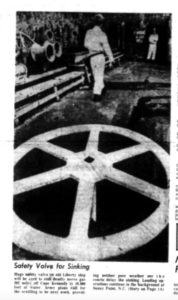
The Today paper ran a photo showing the huge safety valve on the Liberty ship to be sunk with deadly nerve gas 283 miles off Cape Canaveral.
Image courtesy of Tammy Moon, Brevard County Libraries.