
Watch: SailGP’s shocking collision in Auckland’s ‘Mario Kart’ conditions
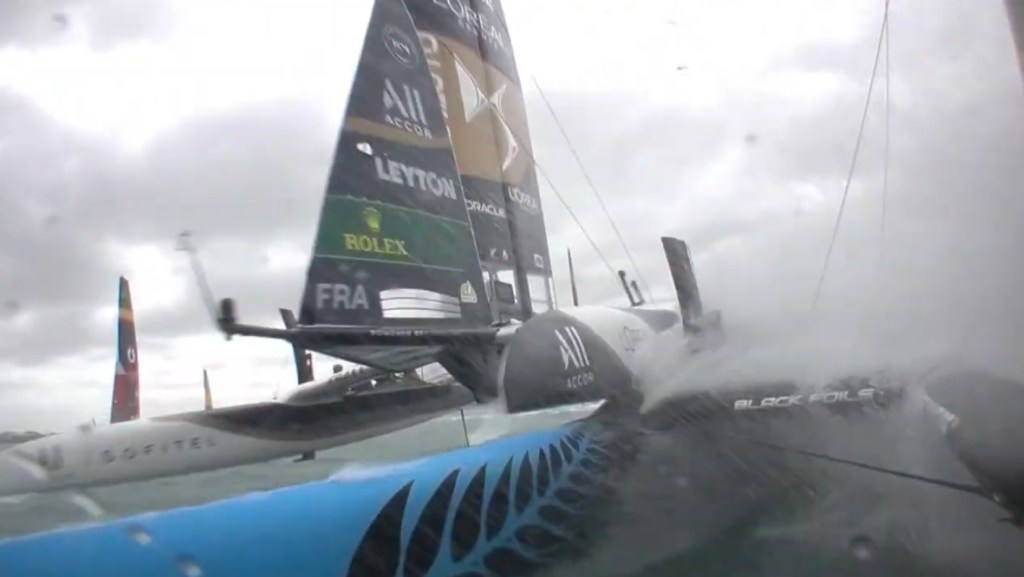 Image courtesy of SailGP footage – Black Foils and DS Team France collision
‘Bullets of wind’, and ‘shifty, wacky conditions, like Mario Kart’ formed the backdrop for the catastrophic collision between two SailGP teams on the opening day of the ITM New Zealand Sail Grand Prix, Auckland.
The incident occurred on 14 February in SailGP’s largest-ever purpose-built stadium — which has been noted as ‘disrupting’ the breeze by the organisers.
It’s yet to be determined what specifically caused the collision but an investigation was opened straight away into the home-team Black Foils and DS Team France collision – see footage below.
Two athletes were taken to hospital in stable condition and all other crew members have been cleared of injuries, an official statement says.
The incident has started an online safety debate, with criticism centred around the tight nature of the course and the number of teams participating in such environs.
“Thirteen boats racing for the first turn at 50 miles per hour was like a dozen trucks racing for the exit to the parking lot,” says one online commentator. “The courses are too small for 13 boats that are going this fast,” adds another. “There were too many boats travelling very fast, in a very small space,” chimes a third.
How the collision unfolded in 22 seconds
The crash occurred at the beginning of fleet race three (22 seconds in), when the Kiwis appeared to lose control of their F50 catamaran at high speed, veering sharply in front of the French. The Black Foils F50 platform collapsed in the incident, as France’s F50 collided on top of the Kiwis’ hull.
The footage below, courtesy of SailGP, shows the incident from various angles.
“I think both teams are quite okay. I want to give my thoughts to the New Zealand team and also to my teammates – this was tough for everyone on both teams,” says DS Team France driver Quentin Delapierre. “On the incident itself, I can’t really say anything. Everything happened so quickly — it’s still super cloudy in my head and I haven’t reviewed the footage or spoken to the umpires.”
A first in SailGP history – thirteen teams on the line
Thirteen international teams were on the startline (for the first time in SailGP history) — on one of the closest racetracks of the 2026 Season calendar – in gusts up to 35km/h. Teams were equipped for top speeds with the 18-metre wingsail, high-speed titanium T-Foils and rudders.
“It was a very tricky race course,” says Bonds Flying Roos driver Tom Slingsby.
“That wind direction is the one here that doesn’t leave much space, so we knew it was going to be tight. Coming into the first mark, you’re getting hit by a lot of bullets of wind and then it goes light, and it’s hard to read the breeze across the track. It was fun racing when everything was going well, but then you’re just trying to stay out of trouble and get the best result you can.”
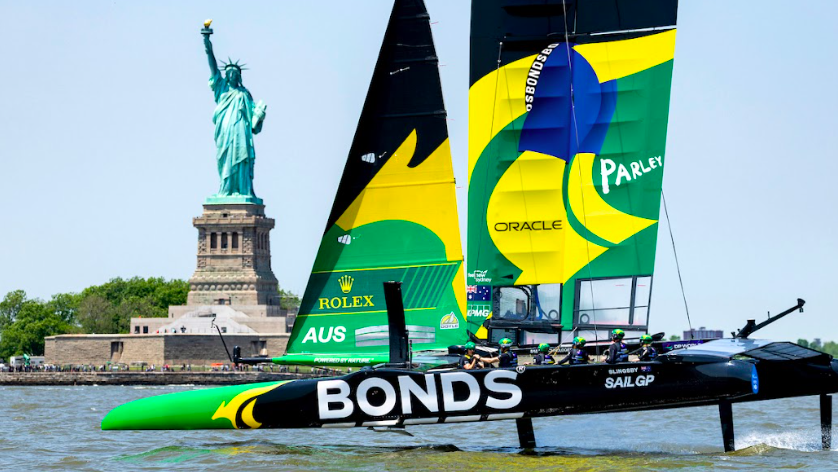
Teams battled unpredictable shifts across the course, with SailGP’s largest-ever purpose-built Race Stadium disrupting the breeze and creating tricky foiling conditions at the bottom of the track. That’s according to the official press statement.
Emirates GBR driver Dylan Fletcher says that “it was a lot of fun until the incident.
“It was shifty, wacky conditions, like Mario Kart out there.”
Are SailGP rules fit for 40 knot racing?
This incident came uncomfortably close to tragedy, says Matt Sheahan.
“Whether involved directly or not, the crash sent shock waves through the fleet. And what made it even worse was that everyone knew this was not an isolated case. The Kiwi dismasting, the Brazilian beam failure. And the American British collision. Each one has seen crews come perilously close to disaster, but this one was uncomfortably close to tragedy.
“It’s easy to see why some are saying that the stakes are getting too high. While the event did deliver its promise of close competition and a winner, Auckland will be remembered for the wrong reasons.”
The video below looks at other incidents which have led up to this moment.
Online backlash and calls for a clean sheet rewrite
Online commentary focuses on the rules being designed for different types of boats.
“The underlying problem is using rules designed for sailboats at 6 knots for race boats at 40+ knots. SailGP needs to do a clean sheet rule and course size requirements designed specifically for this series,” says one commentator. “That means changing who and how right of way is determined, incrementally increasing required safe distance margins with boat speed, having eyes on both sides of the boat at all times, and most importantly what is considered as a safe acceptable avoidance maneuver. Currently none of this is taken into account.”
“A big issue with these boats from the beginning is that they go very fast and can stop very suddenly,” says another.
“This weekend was a wake up call and highlighted the risks that have been obvious for a while now. They need to be addressed or the organisers are likely to be culpable in the event of a death,” notes a third.
However, it’s pointed out: “These are the risks we take as competitors in dangerous sports,” while another says: “It wouldn’t have GP at the end if it wasn’t a high stakes sporting event.”
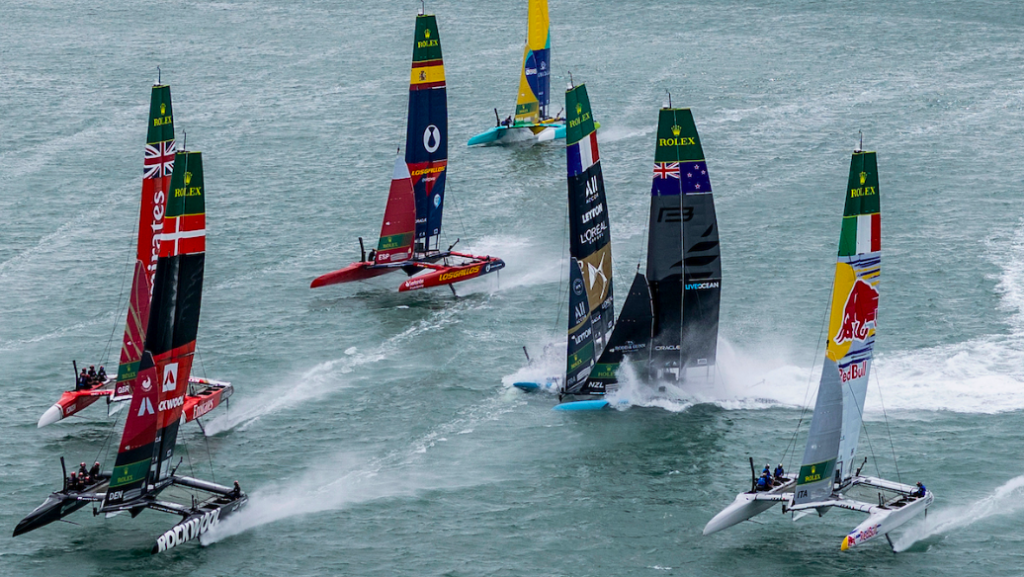
Split fleet racing: SailGP’s immediate response
With strong winds forecast on the subsequent day, SailGP adopted split-fleet format for the first time in racing –=[;… sorting the 11 competing teams into two groups to compete in four split-fleet races, followed by a three-boat final.
More space didn’t mean any less action, as top-end conditions, flat waters and unpredictable shifts put teams through their paces.
High stakes sport or preventable risk?
SailGP has built its identity on speed, spectacle and stadium-style racing. But as the fleet grows faster and tighter, the margins shrink. Whether Auckland becomes a turning point or a warning unheeded may depend less on the investigation’s findings and more on how boldly the series responds to the risks now impossible to ignore.











Leave a Reply