CMC brings propeller development in-house as it expands engineering capability
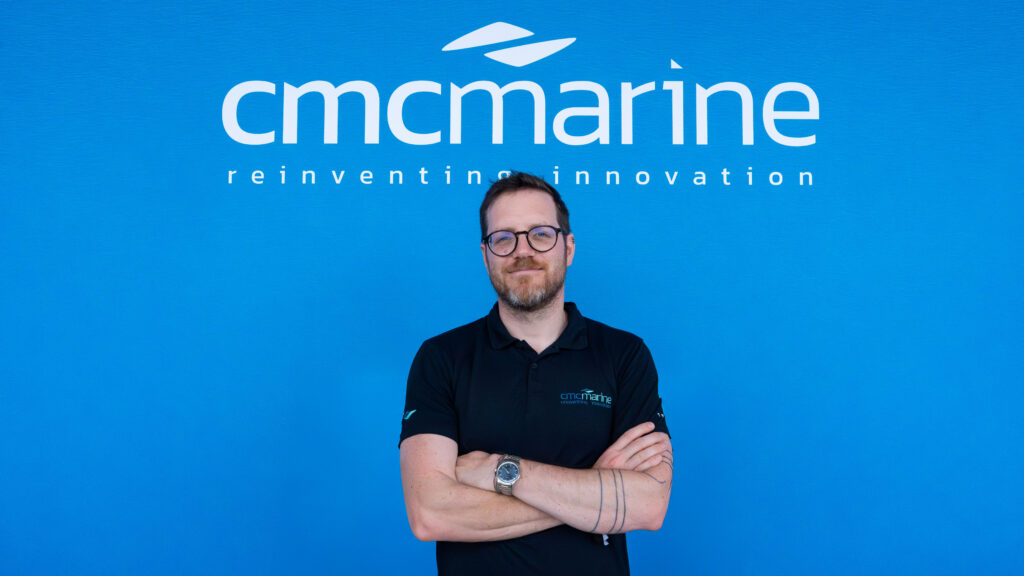 Pietro Cappiello, vice president, CMC Marine
CMC Marine is bringing propeller design and manufacture in-house as part of a wider investment programme aimed at increasing its engineering capability and giving the company greater control over product development and customisation.
The Italian marine equipment manufacturer has invested in a new facility in Salerno, internalising mechanical and fibreglass production, while also increasing its R&D activity through an engineering office in Milan.
“We are now at the point that we can proudly announce that the rollout of the investment plan was really successful,” says vice president Pietro Cappiello.
Bringing more engineering in-house
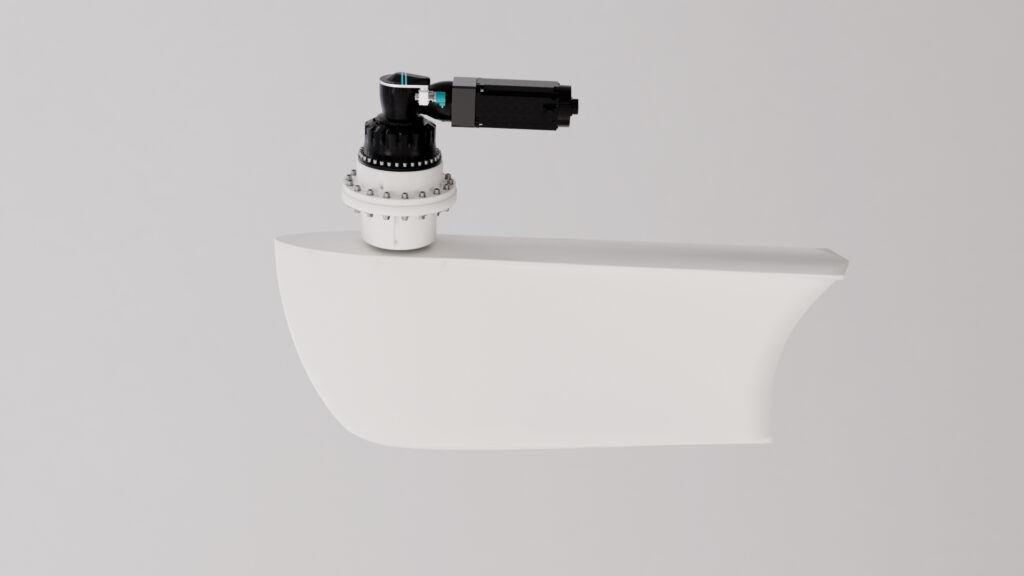
Among the products developed through the investment programme is a new fin shape called LA (low aspect ratio).
Cappiello says the fin was developed entirely within CMC Marine, from the initial shape through CFD calculations, structural design, modelling, mold-making and final manufacture.
“We were able to define the shape, run all the CFD calculation, design the structure, the model, the mold, and completely manufacture it without any third-party supplier,” he says.
The fin has been designed around changing hull shapes and requirements from shipyards; it is intended to improve stabilisation performance at zero speed, while reducing drag and noise underway.
The company has also developed a new propeller shape for its thrusters, again entirely internally.
“We were able to define the propeller, design the propeller, manufacture the propeller, and machine the propeller,” says Cappiello.
He says the design maintains thrust while reducing noise – due to reduced cavitation.
What’s behind a new propeller “is a huge step, technological step in history of CMC.”
The new propeller covers CMC Marine’s full thruster range, which extends from 60 to 250kW and is suitable for yachts up to around 70–80m. The company sells more than 100 thruster units a year, potentially approaching 150, although Cappiello notes that the number is relatively small because of a focus on larger units.

Making a propeller is ‘dark science’
CMC Marine previously sourced its propellers from an external supplier. The decision to bring production in-house reflects both the limited number of specialist suppliers and the complexity of designing and manufacturing the component.
“There are not many suppliers for propellers,” says Cappiello. “It’s [a] hard thing, doing propellers.”
The challenge, he says, extends beyond the design itself, calling the process “dark science” given that it needs a foundry and machining. But, he says, the move into propellers has been well received by shipyards.
“When you approach a shipyard and say, ‘I’m making my propeller now’, they’re like, ‘Okay, now it’s getting interesting’,” he says. “It means that you’re a serious person. If you are able to… have the capacity and the knowledge to design your own propellers, manufacture your own propellers, it means that you’re not joking.”
Five blades and reduced cavitation
Cappiello’s father Alessandro explains that CMC Marine moved from its traditional three-blade design to five blades because of changes in installation requirements.
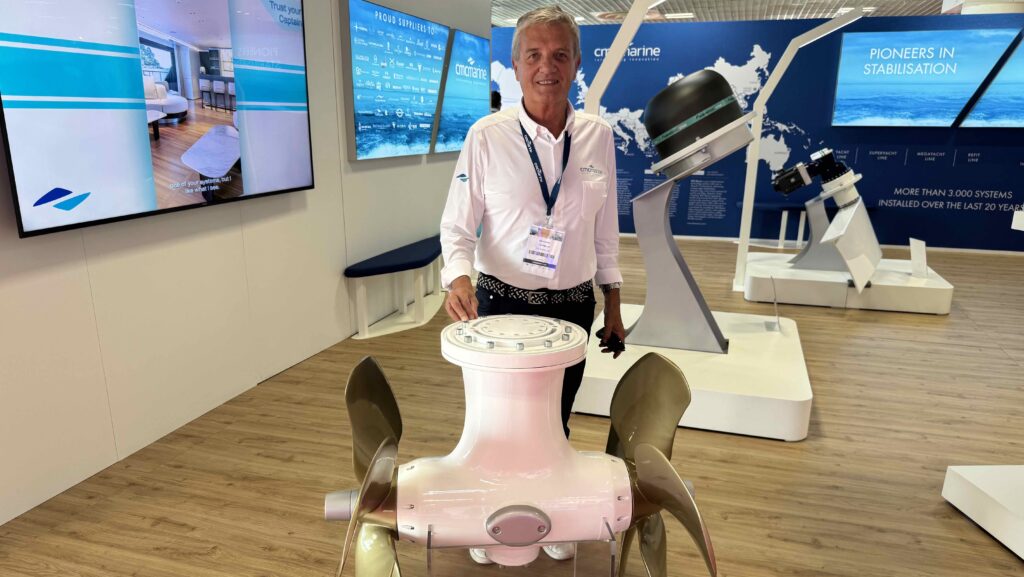
“Traditionally, we had a three-blade propeller,” he says. “But today we have a very narrow beam. So we had to change the installation.”
The new shape is intended to concentrate loading in a particular area of the blade “just to avoid cavitation coming from the inlet of the propeller”.
The company developed software to design and verify the propeller, backed by CFD testing and a database of results, before sending them for casting. Once the casting is received, CMC Marine machines the component.
“Today we have the capacity to verify first, to build, to make the test on board, and to close the loop,” he says.
From €10m to €30m revenue
The investment programme comes after a period of substantial growth for CMC Marine.
Pietro Cappiello says that in 2017, when he joined the company, revenues were less than €10m. The Italian operation is now “stable at 30 million”, excluding the additional activity of its US and UK operations.
The company experienced a major increase during covid, reaching €35m.
“It was crazy,” says Cappiello. “Really tough because you have to deliver, deliver, deliver, deliver.”
CMC Marine has subsequently stabilised at around €30m while continuing to invest.
“You go like one big jump. You settle one big jump, you prepare the ground for the next big jump,” he says.
The company now has around 90 employees across Italy, the US and UK, with facilities and offices including Pisa, Milan, Salerno, Fort Lauderdale and Poole.
A market shifting towards bigger yachts
CMC’s breadth of product range is also intended to provide exposure to different parts of the yacht market. The range extends from around 60ft to 80m, providing some protection when demand moves between segments.
“When one segment of the market is going down, the other one is still strong.”
He believes that the market is currently shifting towards larger yachts, rather than simply declining.
“We see that it’s not that the market is going down, it’s that the market is shifting from smaller to bigger.”
He says shipyards are presenting increasingly large new models, while some custom shipyards report that the typical first-time owner has moved from around 18 to 20m to around 40m.
“In the past you had people that… were sailing with the father, with the grandparents. And then the first yacht was a small one, maybe 10 metre, 12 metre. And then went up 18, then 20, then maybe 24.
“Now, without knowing anything, [a] first time owner has 40 metre.”
Building towards propulsion
CMC Marine’s development plans extend beyond the current propeller launch. The company is continuing to invest on the basis that each stage of development prepares the ground for the next. “You go like one big jump. You settle one big jump, you prepare the ground for the next big jump.”
Cappiello says the company is working on larger thrusters and wants to move towards higher power, with its largest current unit rated at 250kW.
The company also supplies steering gear and rudders, bringing several related systems under its engineering and manufacturing operation.
“All the machines are coming together,” says Cappiello. “We are engineers first.”
For CMC Marine, the propeller development represents more than the addition of another product to its portfolio. It is a move towards controlling more of the engineering, testing and manufacturing process internally, while retaining the knowledge needed to respond to increasingly specific requirements from shipyards.
Prop product development in focus
LA fin
CMC Marine’s new LA (low aspect ratio) fin has been developed entirely in-house, from CFD design through to manufacture. It is designed to improve zero-speed stabilisation while reducing drag and noise when underway.
New five-blade propeller
CMC Marine has developed a new five-blade propeller for its thrusters, replacing the traditional three-blade design. The geometry is designed to manage loading and reduce cavitation, with the aim of maintaining thrust while cutting noise and vibration.
Energy recovery system
The energy recovery system, introduced in 2025, has been tested aboard yachts including Benetti, Cantiere delle Marche and Sanlorenzo. The company says testing has produced “quite impressive” performance, with the system intended to reduce fuel consumption and generator loads.
Bigger thrusters
The company is also developing larger thrusters, with its current range extending from 60kW to 250kW and applications reaching yachts of around 70–80m. CMC Marine says increasing power is part of its future development plans.
This article was amended on 24 September to correct a mis-spelling, and to note that LA stands for low aspect ratio.