Data reshapes performance strategy for Vendée Globe teams
 Lincoln Dews
The next breakthrough in offshore racing may not come from a new foil, sail or weather-routing tool. Instead, it could emerge from the increasingly sophisticated autopilot systems and data platforms being developed behind the scenes as IMOCA teams search for marginal gains ahead of future Vendée Globe campaigns.
“These race boats have been going around the world for years and years and we have a huge amount of data,” says Lincoln Dews, performance analyst and campaign co-skipper, who is helping unlock the technology and performance insights behind Oliver Heer’s 2028 Vendée Globe campaign.
Oliver Heer was the first German-speaking Swiss sailor to ever complete the Vendée Globe, finishing in March 2025. Last November he told MIN that ‘no one’ was waiting for him – in sponsorship terms – and outlined the struggles of making a campaign happen again.
But, in early June this year, he officially christened his boat in Gosport, UK. Heer also recently announced that his team, Embrace The Challenge, will compete in The Ocean Race 2027 before 2028’s Vendée Globe.

Like others in the IMOCA fleet, Heer’s boat carries hundreds of sensors monitoring environmental conditions, vessel motion and structural loads. Data ranges from wind speed, wind direction and water temperature to pitch, heel, roll and yaw, while fibre optic strain sensors embedded in the hull, foils and rig track loads throughout the carbon structure. Direct rig measurements are combined with calculated load models to support both performance analysis and structural engineering.
And Dews needs to make sense of it all.
Hundreds of sensors generating millions of data points
Despite processing data from around 500 sensors at rates of 10 to 100 readings per second, some of the most important performance variables remain difficult to predict. Sea state and wave action continue to challenge modelling.
“It’s a fascinating problem and it’s one of those things where it gets theoretical very quickly, it’s very, very hard to forecast”, he says. Minds all across the marine world – especially in shipping – are currently trying to crack how to model sea states.
“We’re sailing in a very chaotic environment. It’s fluid dynamics.”
Unlike Formula One, for example, there is no fixed track. The constantly changing interaction between waves, wind and boat movement makes offshore racing exceptionally difficult to model numerically especially as modern IMOCAs operate in a complex mix of semi-foiling, semi-planing and displacement modes.
Using data to assess if skippers are sailing boats to design intent
An easier data application is performance validation, confirming whether changes in handling, trim and setup are translating into genuine speed gains.
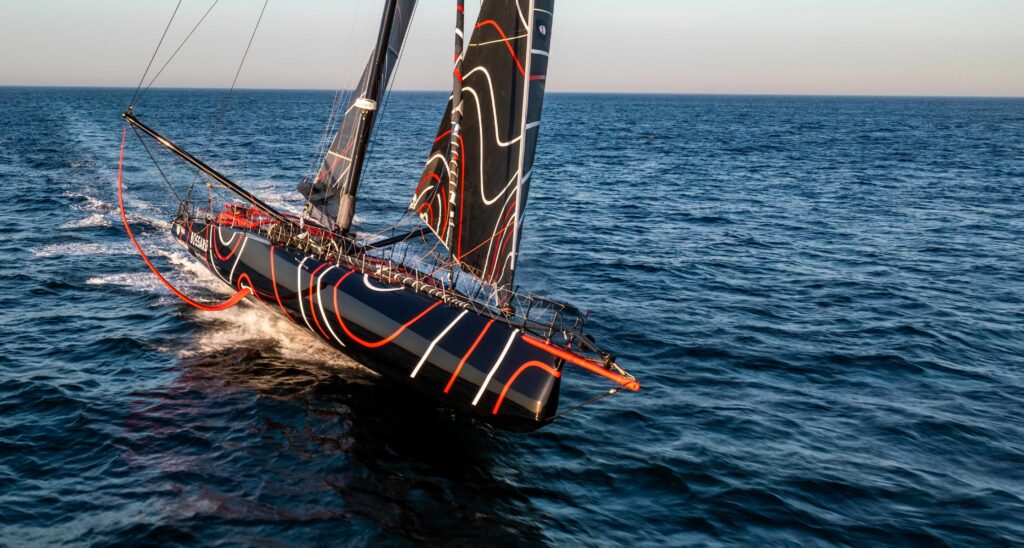
“You’re doing all this work on board to analyse the data, but at the end of the day the most important thing is understanding how fast they can go in certain angles. You’re playing a strategic chess game,” Dews says.
Performance analysis operates on two levels: the controllable settings of the boat itself, and the resulting performance those settings create.
Teams monitor and adjust variables such as foil positions, keel angles and other configurations, while measuring the resulting effects.
“There’s always things to learn in how to sail these boats quicker,” Dews notes. “A lot of the feedback is to try and sail a boat how the naval architects envision the boat being sailed.”
This means looking at measurements (eg heel, trim and leeway), with skippers then adjusting settings to achieve the desired performance characteristics.
Turning data into strategic advantage
High speeds also create strategic opportunities. Conventional offshore boats often seek to maintain efficient upwind angles and optimise velocity made good, whereas IMOCAs are capable of accelerating rapidly and maintaining high speeds across a wider range of sailing angles.
“The beauty of these boats is they accelerate so quickly. In a strategic sense, they really give you a lot of options.”
Understanding how hard an IMOCA can be pushed
With speed to play with, of equal importance is understanding how hard the boat can be pushed in different conditions, and how its performance changes as weather systems evolve.
Conditions ahead of a weather front may be relatively flat, allowing the boat to be driven aggressively, while conditions behind the front can quickly become rougher and place significantly greater loads on both the boat and skipper.
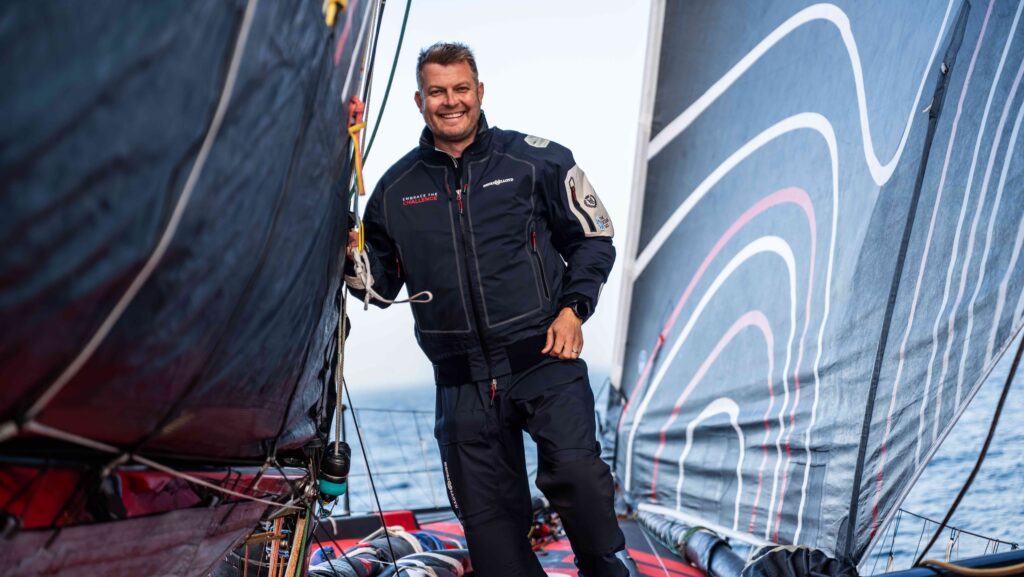
Dews says that this creates a strategic balancing act with skippers and support teams assessing data days in advance about whether the boat can be pushed hard enough to remain ahead of developing weather. If the calculations pay off, substantial gains can be made.
America’s Cup engineers spark offshore racing autopilot arms race
A significant part of the team’s work focuses on validating computer models against real-world performance. The modelling challenge has direct implications for the autopilot.
Autopilots have become one of the most important performance tools for the Vendée Globe, even if the technology has yet to match human helms.
Dew notes that: “It’s still 5-10 per cent quicker” for skippers to manually helm when sailing downwind in an IMOCA. The Vendée Globe’s primarily a downwind race.
That gap helps explain why skippers can still be seen hand-steering during major races.
“If you look at some of these Atlantic races recently there’s still photos of guys and girls sitting up there with helmets on,” he says.
A rapidly changing autopilot market
Yet autopilots remain fundamental to modern IMOCA design, particularly for solo campaigns such as the Vendée Globe.
“It is very hard to drive this boat manually. These boats are built and designed around the fact that you can drive them with an autopilot. Everything from where the rudder stock sits in the rudder, the position of the rudders and other stuff is designed to not have a manual feel.”
The technology around it is evolving rapidly. Dews says a new wave of innovation is emerging.
“Basically, we’re trying to work out what does a human helm use as key intuition to predict the control loop?”
Historically, the IMOCA fleet has relied on a small number of specialist autopilot suppliers. One of the best known is Pixel sur Mer, a Lorient-based marine technology company that develops advanced autopilot and data-management systems used throughout the Vendée Globe fleet. The company supplies systems to many in the IMOCA fleet.
However, Dews says the market is changing rapidly.
“This cycle, there’s probably five or six small startups that are offering solutions.”
He says some of the new entrants are founded by control-systems engineers and specialists arriving from America’s Cup programmes, bringing new approaches to simulation, automation and feedback-loop design.
Autopilots become a major performance investment
For campaign managers, the autopilot investment decision is increasingly being weighed alongside more traditional performance upgrades.
An autopilot “is basically the cost of a new sail, so you decide where your choices are.”
New systems can cost anywhere from around €10,000 to more than €100,000 per season, but for teams chasing marginal gains in a race measured in minutes after months at sea, autopilot development is becoming one of the sport’s most active technological battlegrounds.