Groupe Beneteau issues 2025 business report, CO2 emissions intensity down 26%
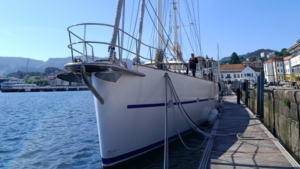
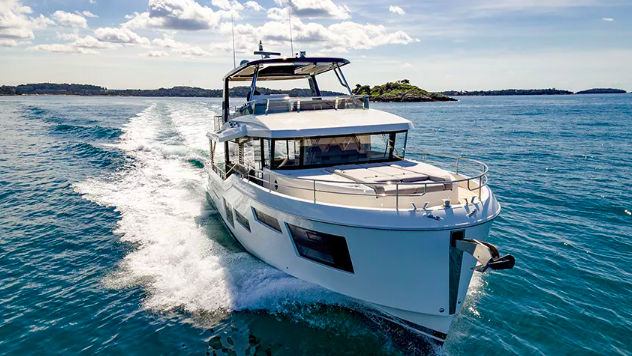 Beneteau’s Grand Trawler 63
Groupe Beneteau has published its 2025 business report, confirming that the firm’s CO2 emissions intensity has fallen by 26 per cent since 2022 across all reporting scopes, while maintaining a target of a 30 per cent reduction by 2030.
Carbon intensity is the amount of greenhouse gas emissions produced per unit of output or activity.
The news comes two weeks after Groupe Beneteau confirmed it is to halt production at its Michigan facility and divest the Four Winns, Glastron and Scarab Jet brands, citing market conditions linked to the Middle East conflict.
“We are making progress in the areas of propulsion systems, materials, the lifecycle of vessels, and services, all with a single goal: to turn our commitments into concrete, implementable solutions. In these areas, we are choosing to take action, experiment, and collaborate with our partners to drive the industry forward,” says Bruno Thivoyon, chair of Groupe Beneteau’s management board.
Part of that work centres on propulsion systems. Groupe Beneteau says it offered 13 models with alternative propulsion systems in 2025, compared with 10 in 2024. The company also announced the creation of E-Lektra Marine, a 50-50 joint venture with Groupe Fountaine Pajot. The project brings together seven brands that, according to the companies involved, account for nearly 60 per cent of the global sailing market and will focus on an open standard for electric propulsion and onboard energy management systems.
The partners say the initiative is intended to support broader use of electric propulsion technology, with a target of reaching between 10 and 15 per cent adoption in the global sailing market by 2030.
The report also highlights work on materials and recycling processes. Groupe Beneteau states that its facilities produced 4,400 parts made with hemp fibres during 2025, using 5,500kg of material sourced through a supply chain in the Vendée region. According to the company, using those fibres alongside resin containing 35 per cent bio-based material reduced greenhouse gas emissions linked to those components by 24 per cent and lowered fossil resource consumption by 35 per cent. The company says this represents 11 metric tonnes of avoided CO2 emissions.
Work involving Elium recyclable resin is also continuing. Groupe Beneteau says it has used 12.6 metric tonnes of the resin together with 14 metric tonnes of recycled or natural fibres.
In April 2026, Excess introduced the Excess 11, which the company describes as the first production multihull to use Elium recyclable resin. The company is also working with Arkema, Composite Recycling, Owens Corning, Chomarat and Veolia on a system designed to recover and reuse materials from production waste and, over time, from end-of-life vessels.
Groupe Beneteau’s report also covers activity beyond new vessel production. The company says its refit programme targets between 30 and 40 vessels a year, while the acquisition of BMS Shipyard in France expands those capabilities.
Shared-use services continue to grow as well. Groupe Beneteau reports that 1,010 subscribers used 110 self-service boats during 2025. The company also says nearly 15,000 boats are equipped with Seanapps, representing a 50 per cent increase compared with the previous year.
The report also sets out workforce figures and training activity. Groupe Beneteau says more than 92,000 hours of training were delivered to its 6,200 employees during 2025. Its mentoring programme involved 715 mentor-mentee pairings across 43 industrial trades, accounting for 32,400 hours of workplace training.
The workplace accident rate fell from 15 to 12.3, while women represented 32.5 per cent of the workforce. The company has set a target of 40 per cent by 2030.
The full report is available online.