Flexiteek’s development story, from Metstrade to global leader
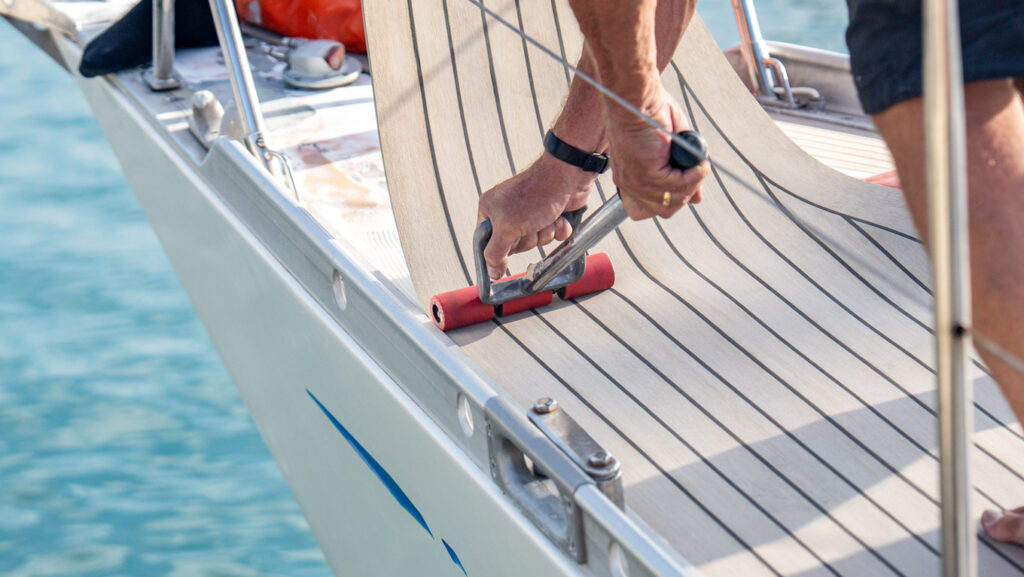 Installation of Flexiteek by Yacht-Tek Espania
Flexiteek emerged when synthetic alternatives to traditional teak were still a niche idea, tested more in concept than in mainstream boatbuilding. First introduced around the turn of the millennium at boat shows, including Metstrade, the product entered a market that had yet to define what modern synthetic marine decking could become. Over the following two decades, it’s evolved through material innovation, industry collaboration and strategic consolidation into one of the most widely used alternatives to natural teak in global boating.
MIN visits Flexiteek’s factory in Essex, UK, to understand its history.
Flexiteek is a synthetic marine decking system developed as an alternative to natural teak, designed to reduce maintenance demands while replicating the appearance and performance of traditional wooden decks.
Early development and industry scepticism
The product was first introduced in 2000, originating from an idea developed by Anders Wilhelmsen, chairman of Watrium in Oslo. At launch, synthetic decking was still a niche category, with limited alternatives outside the US market and no formal exhibition presence.
Early commercial development accelerated after the appointment of chief executive Thomas Gustafsson in 2006. The first-generation product was manufactured externally. During this period, the Wilks business, established in 1973 and manufacturing marine fendering and rub rail products, was developing its own decking brand, Dek-King.
Over time, Wilks and Flexiteek worked increasingly closely together, with Wilks producing Flexiteek decking before the relationship culminated in Flexiteek’s acquisition of Wilks in 2019 and the managed transfer of production to its Essex facility, bringing extrusion and manufacturing in-house and consolidating operations.
First-generation installations still in service
First-generation installations of patented Flexiteek 1G from this early period remain in service more than two decades later, including decks fitted to boats launched in 2000 and 2001 such as Hansa yachts. These long-term installations underpin the product’s emphasis on durability and service life, with many early decks remaining operational after 26 years.
Second iteration – Flexiteek2G – launched 14 years later
Product development has progressed through a structured series of generations rather than frequent redesigns. Flexiteek 2G was launched in 2014 and represented a significant technological step forward, with a focus on being lighter weight than alternatives, improved colour performance, cooler in warmer locations and UV stability. This development also saw a change in the use of plasticisers, from ortho-phthalates to non-ortho phthalates.
Flexiteek 3 brings a bio-approach
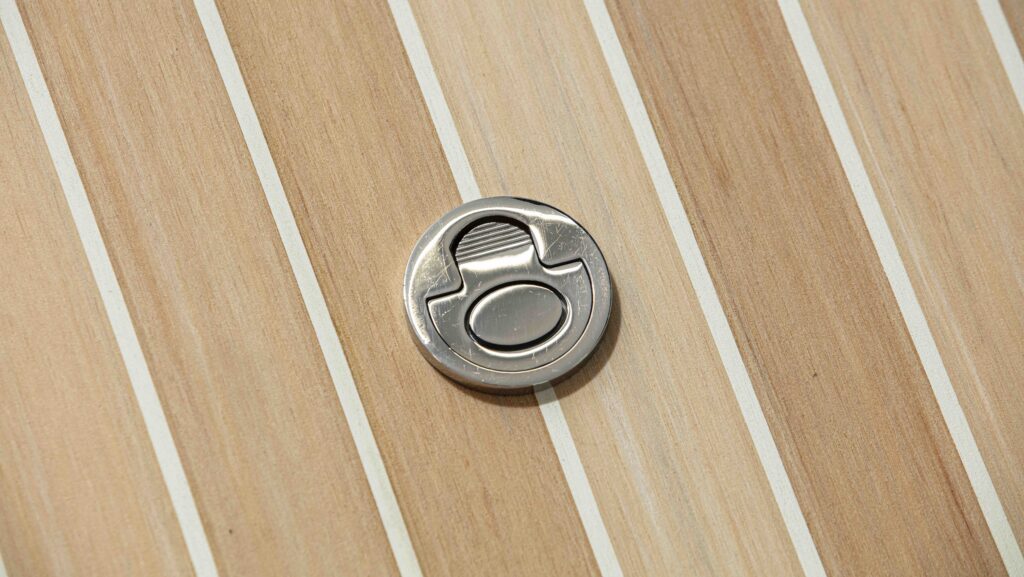
The next major evolution, Flexiteek 3, was introduced in 2024. Phthalate-based plasticisers were removed entirely, eliminating substances associated with potential health concerns while maintaining flexibility and durability.
This version replaced fossil fuel-derived components in the PVC compound with a bio-attributed alternative derived from tall oil, a by-product of pine tree processing sourced from responsibly managed forestry-linked industries such as paper, furniture and construction materials.
Improving UV stability, colour and performance
The material change delivered improved cooling, durability, UV stability and colour retention, alongside increased resistance to onboard contaminants including oil, red wine, fish blood and food stains. Flexiteek 3’s closed cell structure also allows most routine cleaning to be carried out using fresh water, reducing reliance on specialist cleaning products.
Independent testing
Across its development history, product performance has been validated through independent testing conducted in facilities including Germany and Sweden, covering wear resistance, heat performance, UV stability and high-traffic simulation equivalent to extended real-world use.
Installing Flexiteek with tape
Installation methods have also evolved alongside material changes. Decking is bonded to vessels using marine adhesives following templating and fabrication of panels from individual strips. Fabrication and installation procedures include controlled warming of materials, accurate panel assembly and approved bonding processes. Installation methods include weighted systems and vacuum-based techniques, with vacuum systems providing higher placement precision. A thinner 3.5mm product variant enables installation using 3M tape rather than traditional adhesives, allowing immediate walk-on use and faster production-line installation compared with curing-based systems.
Available profiles for synthetic decking
The product range includes multiple profiles designed for different vessel types and layouts, including 2×45, 4×45 and 2×60 configurations, as well as margins and king plank sections. King plank elements can be CNC-machined into custom patterns, branding and bespoke deck designs.
The system is available in more than 15 colourways, with batch coding and tracking used to maintain consistency across installations while allowing for controlled variation that reflects natural timber.
Manufacturing is supported by central production with fabrication carried out across a global distribution network, including operations in Denmark, Poland and the United States, alongside distributor facilities worldwide.
The constant expansion of the company has led to the use of external storage capacity to manage inventory, reduce lead times, and support global demand.
Long-term durability and real-world validation
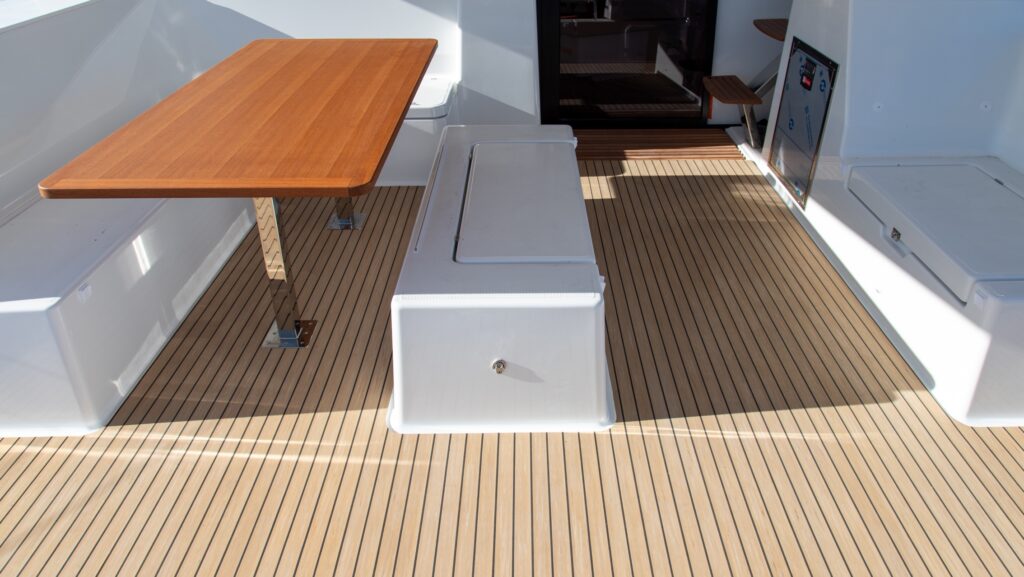
The product has been designed for durability and reduced maintenance compared with natural teak. User issues relate primarily to maintenance rather than product failure, often involving staining from substances such as ketchup or red wine left on the surface for extended periods.
Improvements introduced in Flexiteek 3 have increased stain resistance and reduced cleaning requirements, with many marks removable using fresh water alone.
Longevity and lifecycle value are central to its positioning, with comparisons to teak decks over a 25-year period highlighting reduced maintenance, fewer repairs and lower overall lifetime cost. Natural teak decks may weather, require resealing or involve structural maintenance in high-traffic areas, while synthetic decking reduces the frequency of such interventions.
Flexiteek goes beyond decking
Beyond decking, the material is also used in applications including utility vehicles such as Land Rovers, as well as marine bathrooms, showers and other high-wear surfaces due to its durability and water resistance. The material can be CNC-machined into customised surfaces for both functional and design applications.
Consolidation into a global marine materials business
A bio-attributed PVC transition in Flexiteek 3 reflects a shift towards reducing reliance on fossil fuel-derived inputs, with further product developments under active research and development focusing on usability, performance and environmental impact.
The development of the Wilks range continues within the broader business, including products such as Click, a track-and-fender system introduced in 2022 and promoted more widely in 2023. Recent strategy has included renewed focus on brand integration, expansion at Metstrade, increased industry sponsorship activity and greater international visibility, particularly in North America and Northern Europe.
Is Flexiteek environmentally sound?
As well as its developments with Flexiteek 3 outlined above, the company’s sustainability initiatives include habitat restoration and reforestation programmes in partnership with organisations such as the World Land Trust, alongside participation in EcoVadis assessments prompted by OEM requirements, including Beneteau. The business holds an EcoVadis Silver rating and is undertaking carbon assessment work. More information is available on the company’s website.
From early PVC formulations and limited market acceptance to today’s engineered, UV-stable and performance-tested decking systems, the evolution of Flexiteek reflects a broader shift in marine materials science. Through product generations, manufacturing refinement and strategic growth – including the integration of Wilks into its business – the company has helped redefine what sustainability and in particular synthetic teak can deliver, both technically and commercially, for global marine markets.