Oil tankers hit, GPS spoofed and ships stranded: confusion spreads across Strait of Hormuz
As of 13 March 2026, at least six or seven vessels – including oil tankers – have been struck by projectiles or explosive-laden boats in the Strait of Hormuz and the wider Persian Gulf within a 48-hour period, according to information gathered by Marine Industry News.
The surge in attacks is severely disrupting shipping through one of the world’s most critical arteries for oil and global trade. Some reports suggest as many as 20 vessels have been impacted since the conflict began, pulling the global maritime sector directly into a rapidly escalating regional crisis.
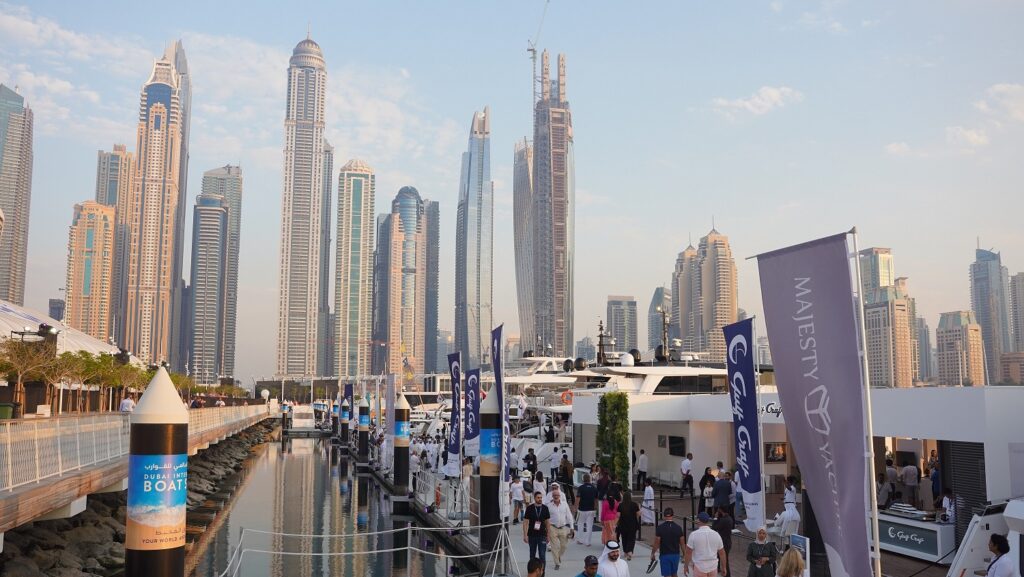
Amid the worsening security situation, major industry events have already been affected, with the Dubai International Boat Show ‘postponed’ as tensions and risks across Gulf waters continue to rise.
Scott Bessent (US treasury secretary) yesterday (12 March) told Sky News: “My belief is that as soon as it is militarily possible, the US Navy, perhaps with an international coalition, will be escorting vessels through.
“There are, in fact, tankers coming through now, Iranian tankers, I believe some Chinese flag tankers have come through. So we know that they have not mined the straits.”
The threats to, and attacks on, shipping continue
With no publicly clear end-point for the USA or Israel being offered, the conflict looks set to continue, with shipping being used as a high-stake lever.
“I assure everyone that we will not neglect avenging the blood of your martyrs,” the new supreme leader Mojtaba Khamenei (also hardline cleric) relayed via Iranian state television. “The popular demand is to continue our effective defence and make the enemy regret it.
“The lever of blocking the Strait of Hormuz must continue to be used.”
A fifth of global oil normally passes along Iran’s coast.
Two tankers were ablaze in an Iraqi port yesterday, reports Reuters, after a hit by suspected Iranian explosive-laden boats. The ships in Basra were engulfed in massive orange fireballs and at least one crew member was killed.
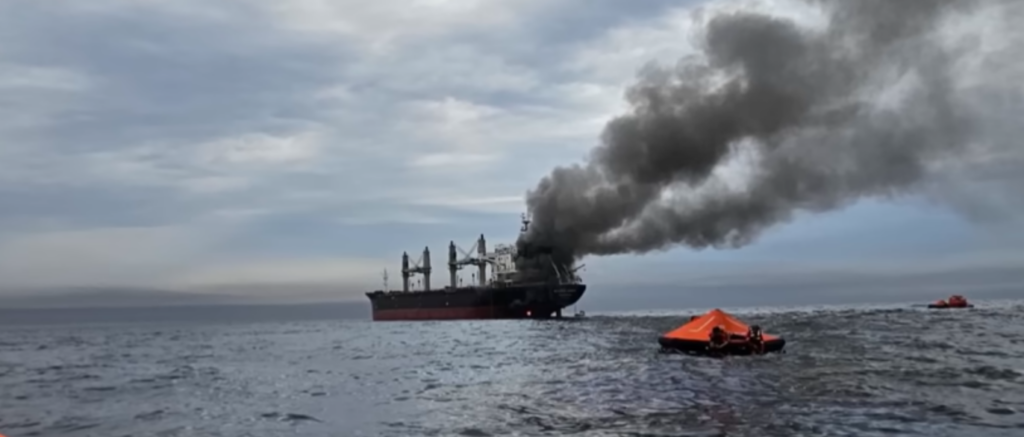
Hours earlier, three other ships were struck in the Gulf. Iran’s Revolutionary Guards claimed responsibility for at least one attack – on a Thai bulk carrier that was set ablaze (main image above). Another container vessel reported being struck by an unknown projectile near the United Arab Emirates.
Details of shipping attacks collated
United Kingdom Maritime Trade Operations (UKMTO) is detailing each attack. The organisation helps protect crucial trade routes by providing mariners, shipping companies, and regional authorities with essential, verified and corroborated security information.
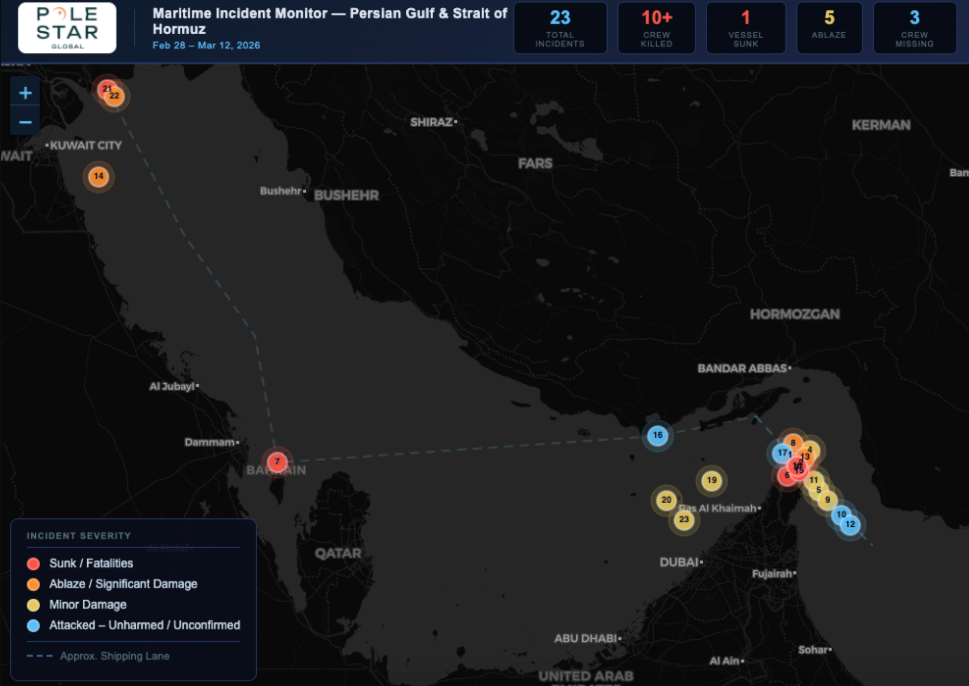
UKMTO says it has received 20 reports of incidents affecting vessels operating in and around the Arabian Gulf, Strait of Hormuz (SOH), and Gulf of Oman, between 28 February – 12 March 2026.
‘The master has reported the container ship was struck by unknown projectile causing a small fire onboard. Full damage assessment impaired by darkness. All crew are reported as safe. No environmental impact has been reported at this time. Authorities are investigating,’ says one report.
All reports conclude: ‘Vessels are advised to transit with caution and report any suspicious activity to UKMTO.’
Hormuz Strait becomes a digital minefield
Beyond the physical attacks, a second battle is unfolding in the digital domain.
Since 5 March, maritime intelligence firm Pole Star Global has been tracking 3,396 vessels operating in and around the Strait of Hormuz. The sudden outbreak of conflict has left many ships effectively stranded at sea as Iran uses the strategic chokepoint to exert pressure in its confrontation with the USA and Israel.
“Our data offers an unusually granular view into how conflict, coercion and digital deception are reshaping global trade in real time – and where the next fractures might appear,” says Saleem Khan, chief data and analytics officer at Pole Star Global.
Ships using tracking signals as political messages?
The data suggests vessels are increasingly using their tracking signals to broadcast political messages in an attempt to avoid becoming targets. Some ships leaving the region have begun transmitting unusual destinations such as “China Owner and All Crew” via AIS – a signal that can be interpreted as a plea: don’t shoot, we’re not your target.
Pole Star Global uses AIS transmissions, satellite detections, ownership data and behavioural analytics to help governments, insurers and shipping companies distinguish technical malfunctions from deliberate manipulation.
What Khan is seeing suggests data manipulation is widespread. He has a front row seat to watch the dire mess unfold and the tactics being used for vessels to disguise who-what-and where they are … or as he terms it: suspicious positional anomalies.
He cites one vessel, NV Aquamarine. It appeared to travel at an impossible speed of 102 knots (188 km/h) from the Strait of Hormuz towards the Iran–Iraq border.
“That is impossible for a tanker capable of carrying 350,000 barrels of oil worth around $35 million at current spot rates.”
Instead, the anomaly points to deliberate AIS manipulation.
According to Khan’s analysis, roughly one in every 15 vessels in the area – around 231 ships – is exhibiting suspicious positional anomalies. These include vessels appearing to ‘jump’ vast distances, disappearing briefly from tracking systems before reappearing, or displaying patterns consistent with GPS and AIS interference.
“This is no longer a story about isolated glitches. It’s a systematic, geographically clustered distortion of reality at sea.”
Hundreds of tankers left waiting for orders
At the same time, Khan notes there is a near‑total cessation of commercial traffic.
“Beyond the chokepoint, about 540 oil tankers carrying an estimated 314 million barrels are currently at sea with no fixed destination, listed simply as ‘awaiting orders. That’s effectively a $30 billion floating oil exchange waiting for a safe route and a safe buyer.”
Sailors describe missiles and drones overhead
Sailors stranded on oil tankers and freight ships in the Gulf now have horrific personal insight into drones, cruise missiles and fighter jets.
“I have seen Iranian drones and cruise missiles flying at low altitude,” a Pakistani sailor – stranded on an oil tanker in the United Arab Emirates – told the BBC. “I also hear the sound of fighter jets, but we can’t identify which country they belong to.”
His colleague, a sailor from Myanmar, added his thoughts.
“Just this morning, two fighter jets fired at each other while we were still working. There’s no specific hiding place on the ship for this, and we just had to run inside.”
A captain who works on oil tankers added that he believes that when it comes to avoiding attack, there is little difference between being at port or sea: “If they want to target my ship they will target it.”
The navigation systems ships depend on are vulnerable
“Reports of vessels in the Persian Gulf having their GPS signals spoofed, and others transiting the Strait of Hormuz with AIS signals switched off, have drawn attention to a growing operational reality for commercial shipping,” says Yarden Gross, CEO and co-founder of Orca AI.
Operators may face new dilemmas in areas of tension about whether to remain visible through cooperative systems such as AIS, or continuing to sail while relying on the radar alone.
The circumstances influencing these decisions are complex, Gross believes.
“But the situation highlights a broader issue the industry must confront: modern navigation relies heavily on satellite-based signals that are increasingly vulnerable.”
The Gulf and Strait of Hormuz is the latest and most acute example of this growing vulnerability. Gross calculates that widespread GPS and AIS interference has disrupted the navigation systems of more than 1,650 commercial vessels across the Gulf. In some cases, tracking data has shown ships located at airports, on land or going around in circles – classic indicators of spoofing.
Shadow fleet activity adds uncertainty
“This interference can originate not only from land-based systems but also from other vessels, including ships engaged in sanctioned or ‘shadow fleet’ activity, adding further uncertainty to the navigational environment.
“Including the withdrawal of war-risks insurance, the present situation has sparked severe operational disruption. More than 150 tankers and LNG carriers are currently anchored or waiting in the Gulf as operators delay Hormuz transits. With parts of the compliant tanker fleet sitting idle or rerouting, day rates have surged to record levels of USD 700,000-plus per day.”
The consequences extend far beyond individual vessels. Disruption to the movement of oil and gas to global markets is creating severe knock-on effects for maritime supply chains and for the wider world economy.

“The result of sustained GNSS interference is effectively an ‘electronic fog’ as the shared digital picture of maritime traffic – the foundation on which many monitoring and navigation systems depend – becomes unreliable or misleading.
“This phenomenon has also become increasingly common in other regions affected by geopolitical tension, such as the Baltic and Black Seas, rapidly making what were once considered exceptional disruptions into normal operational risk,” notes Gross.
Benign environment for AIS rapidly changing
The crisis in the Gulf illustrates a broader shift across the maritime domain. For decades, AIS and satellite positioning operated in a largely benign environment. That assumption is increasingly being challenged as electronic interference becomes a routine feature of geopolitical conflict.
“The question is therefore not whether AIS, GPS or other digital systems will remain central to navigation – they will. But whether vessels can maintain safe situational awareness when those signals fail.”
Gross continues: “Mariners have always understood the value of layered awareness. No single sensor or system should be relied upon in isolation. Radar detects physical objects regardless of whether they transmit signals. Human lookout remains a legal and operational requirement under the COLREGs. Electronic charts provide geographic context. Together, these tools allow navigators to verify what they see.”
Gross, whose company delivers AI-driven situational awareness, says new technologies are strengthening this layered model. And unlike AIS, they do not depend on other vessels transmitting information.
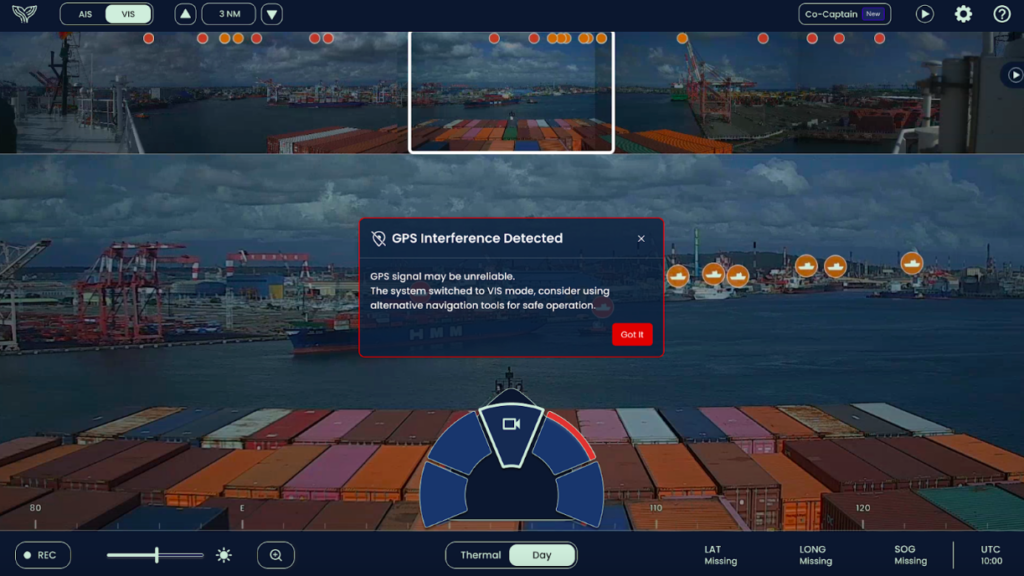
AI-assisted situational awareness can help provide assurance
“Computer vision and AI now allow visual data from cameras (including thermal cameras) installed around a vessel to be analysed continuously, detecting and classifying objects in real time. By providing an independent visual reference of surrounding vessels and obstacles, and alerting the bridge team when risks emerge, AI-assisted situational awareness provides an additional, independent layer of perception alongside radar and human lookout.
“These technologies are not intended to replace seafarer judgement or traditional navigational systems. They are designed to complement them, helping bridge teams maintain situational awareness in critical conditions such as darkness, poor visibility, congested waterways or when positioning and tracking data become unreliable.
“Networked awareness further reinforces this model by creating what we call a ‘collective mind’ of sea captains. In an era where ships are no longer ‘islands,’ cloud connectivity allows the visual detections of one vessel to act as a sensor for the entire fleet. When interference or signal degradation is detected, these real-time hotspots are mapped and shared instantly. This gives navigators (and just as importantly, shore-side fleet managers) the ‘digital truth’ needed to recognise and respond to disruptions before they become crises, transforming the bridge team from reactive lookouts into proactive system supervisors.”
IMO warns seafarers must not become targets
Meanwhile, IMO has called an extraordinary council meeting.
“Around 20,000 seafarers remain stranded in the Persian Gulf, on board ships under heightened risk and considerable mental strain,” relays the secretary-general of the International Maritime Organization (IMO), Arsenio Dominguez, adding to the widespread opinion that seafarers must not be targets.
The organisation says it remains deeply concerned about the wellbeing and safety of seafarers affected by the ongoing situation. Around 20,000 seafarers, along with cruise ship passengers, port workers and offshore crews, are impacted in the region.
While the disruption to global trade is significant, IMO’s primary concern remains the humanitarian and safety implications for seafarers on board ships operating in the area.
Speaking about the casualties on 6 March, Dominguez says: “This is unacceptable and unsustainable. All parties and stakeholders have an obligation to take necessary measures to ensure the protection of seafarers, including their rights and well-being, and the freedom of navigation, in accordance with international law.”











Leave a Reply