Omaya Yachts came to Cannes without a boat. Here’s why
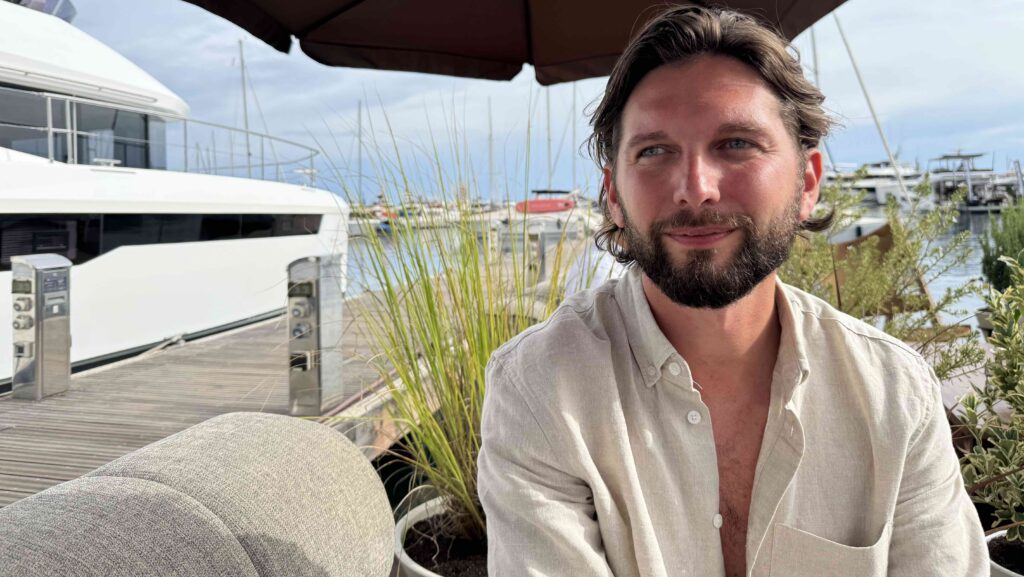 Kaloyan Radulov is Omaya Yachts’ co-founder and general manager
Dangerously low levels on the Danube River left Omaya Yachts without its boat at the Cannes Yachting Festival, but the Bulgarian builder is using the setback to make a bigger argument about the catamaran market. Founder Kaloyan Radulov believes established builders have left a gap between the best monohulls and today’s power cats, and he wants Omaya to fill it – teeing up the forthcoming Omaya 53 as an example.
Low Danube levels leave Omaya without a boat at Cannes
Kaloyan Radulov sits on his stand at Cannes Yachting Festival – a giant empty berth behind him. It should be taken by the Omaya 50. But because of the dangerously low levels of the Danube River, the Bulgarian shipbuilder refused to risk the journey.
“The levels are very low. Our draft – with the propeller and everything – is around 160cm, and there are some sections of the river that we have to go through that are around two metres,” he says. Last year Omaya launched its boat at plus 280cm; this year it launched it at minus 80.
Then there are the sandbanks.
“We decided to not navigate through,” says Radulov ruefully, but adds the company’s going to Genoa instead.
“Whoever is a serious buyer, they will come to Genoa for sure.”
That passage is also fraught with its own issues. “After we pass [the] Black Sea, and we go to the Mediterranean, there is a big chance of storms and bad weather. So I hope that we don’t send all our leads to Genoa, and then we are stuck in the middle of the trip somewhere.”
In late July, Bulgarian border police evacuated 186 passengers from a Viking Cruises ship. Viking Ullur ran aground on a sandbank on the Danube as exceptionally low water levels disrupted river cruising and shipping across Central Europe.
Launch of the Omaya 53 concept
With its plans to show off the Omaya 50 at CYF marooned, the company’s full steam ahead on talking about the Omaya 53 due to launch in 2028.
It is the next development of the 50, using its 16.03m platform to maximise living space and flexibility rather than simply adding length. Its enlarged aft cockpit is designed as an open living area for dining, lounging or sunbathing, while a high-low bathing platform can sit flush with the deck, drop to the transom level or submerge by around 0.5m. With a 400kg payload, it can also handle a tender or jet ski. The flybridge similarly uses movable furniture rather than fixed sunbeds.
Moving the machinery further aft has freed up accommodation. The owner version has a full port hull dedicated to the owner’s suite, with two en-suite guest cabins in the starboard hull and separate skipper/crew accommodation. A four-cabin version is available for premium charter.
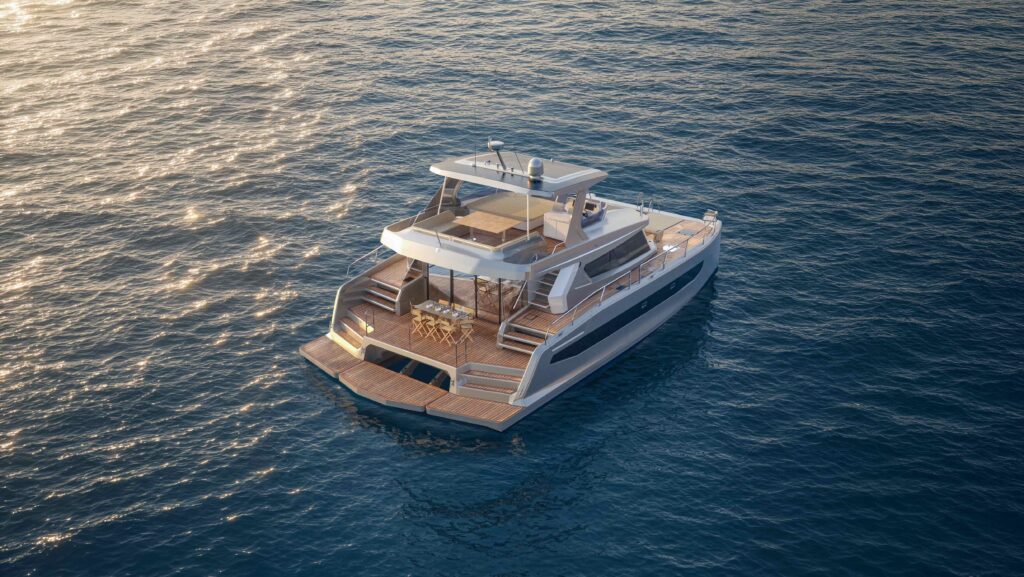
The Omaya 53 is the first model in the range planned around Volvo Penta IPS, with twin D6-IPS400s as standard and higher-powered options up to D6-IPS650. Projected performance is 23 knots maximum, 15 knots cruising and 650 nautical miles range, subject to sea-trial validation.
Built in vinyl ester and glass fibre with carbon reinforcement where required, the yacht uses vacuum-infused composite construction, with CNC, mould-making and furniture production carried out in-house.
Omaya wants to win over monohull buyers
The lack of a boat at CYF has not stopped interest. Radulov says the team has been busy with commercial meetings, with CYF visitors telling them they have been following the brand for up to two years – providing useful evidence that the marketing is working.
He’s also using the show to look beyond the catamaran sector, particularly at what established monohull brands are doing in terms of design, materials and space. According to Radulov, there’s a significant gap between the best monohulls and the current catamaran offering, and he believes smaller, more flexible brands can use that gap to their advantage.
The advantage looks like an opportunity to attract monohull buyers who don’t see a catamaran offering the same quality level as companies such as Princess and Sanlorenzo. A catamaran can potentially offer comparable living space on a shorter platform, he argues, creating a proposition that is not simply about building a cheaper boat but about using its dimensions better.
That also supports his argument for being a new Bulgarian brand. He believes buyers are becoming less tied to established names and that newer brands can challenge that loyalty by offering a different proposition. Radulov compares the shift to the automotive market, where buyers in European cities are increasingly willing to consider Chinese and other foreign brands rather than automatically choosing established names such as BMW or Mercedes. The same change could create an opening in yachting for brands from less traditional manufacturing markets, including Bulgaria.
For the company, that means challenging the assumption that a yacht buyer must choose one of the established European names to get the level of design, materials, and engineering they expect. Radulov argues that buyers should be able to visit the company’s Bulgarian yard, see its 15,000 sq m built area and understand that a boat produced there can be a credible alternative.
The Omaya 50 as a year-round vacation home
Next on his list is selling hull numbers two and three of the Omaya 50 as all-season boats (full details are online). The emphasis is on boats being vacation homes for year-round use. This, Radulov says, is especially aimed at private owners spending €2m on an asset. “Why don’t you use it in an extended season, even outside of the active season?”
“And you can do it because you have a dining table for 12 people. You have a 50-inch TV. You have a fully equipped galley. You have a double-door fridge. So basically you don’t have anything missing from your home.
“This can basically be your vacation home.”

The Omaya 50 is designed to maximise usable interior volume, light, and all-season living. It features a large saloon and generous windows. Unlike the typical Mediterranean layout, which prioritises a large aft cockpit, the design sacrifices some aft cockpit space for a much larger saloon, complemented by a generous forward cockpit and a large flybridge. This helps to create a boat that can be used comfortably with family and friends throughout the year.
Why Radulov rejects headline-led sustainability claims
Radulov – well known for his outspoken comments on greenwashing – says his approach to sustainability is less about headline technologies such as electric propulsion, methanol or recyclable materials, and more about reducing resource use across a boat’s lifetime. He sees efficiency as the starting point: the Omaya 50 can use current diesel technology without excessive fuel consumption, aiming to burn around 35 litres per hour at 9.5–10 knots.
Durability, maintenance and serviceability are also central to Omaya’s approach. Components should be accessible and easy to maintain, rather than hidden away until they fail, while boats should be designed to be refitted rather than replaced.
“The most sustainable boat is a refitted boat,” he says, arguing that extending the life of an existing boat can have a far lower carbon footprint than building a new one.
He also wants future models to be designed for changing technology. Engine rooms, electrical systems and other key spaces should be accessible enough to accommodate new propulsion and energy technologies as they develop, without requiring the boat to be rebuilt. For him, this is what future-proofing means: “How do we ensure that we spend fewer resources so that we can leave enough for the future generation?”
While Radulov is excited for what is to come, the last 12 months haven’t been as successful as he’d hoped, which he puts down to several factors.
“First, we’re a new brand. Second, there’s this geopolitical crisis that many people are complaining about. I don’t know why it stops you from buying a yacht, but I guess you want to keep your fortune if something happens.
“Luckily for us, we’re a small manufacturer, so we don’t have to sell 180 boats.”
For now, Omaya’s next test is getting the boat to Genoa, where Radulov hopes potential buyers can experience it on the water. Beyond that, his ambition is broader: to establish a Bulgarian yacht brand that can persuade buyers to look beyond familiar names, while building boats designed to remain useful, repairable and adaptable for longer.