The Italian Sea Group faces €270m overdue debt as court-supervised rescue reaches crunch point
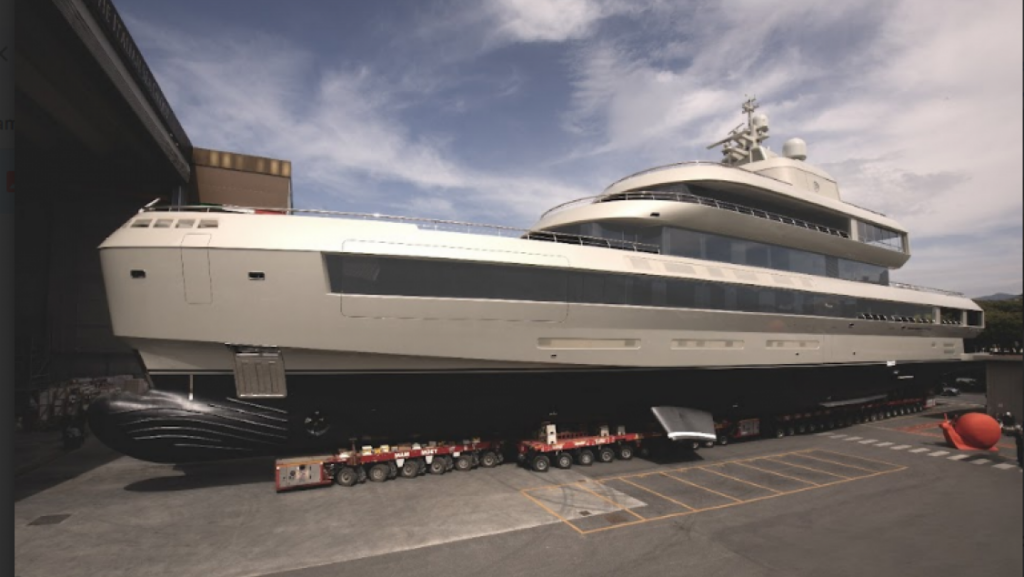 Launch of the megayacht Admiral Armani 72m, by The Italian Sea Group
The stark message surrounding The Italian Sea Group is that its €270m of overdue liabilities are rising rather than falling. The figure is thought to have increased by around €12m between June and July, as the Italian superyacht builder moves through a formal, court-supervised restructuring process.
Recently published figures show €270.04m of overdue liabilities at 31 July 2026, up from €257.7m at the end of June, including €98.4m owed to factoring companies, €85.7m to suppliers, €48.7m to financial institutions, €17.6m in tax liabilities and €19.6m in social security liabilities. TISG’s consolidated net financial position was €179.6m negative, comprising €148.9m of bank debt and €5.3m of cash.
The crisis is underpinned by the continuing fallout from the August 2024 sinking of the superyacht Bayesian, built under TISG’s Perini Navi brand. TISG has argued that the disaster – which resulted in the immediate death of seven people, plus a Dutch rescue diver – caused severe commercial damage to Perini and has launched a €456m damages claim against the yacht’s owner, Revtom, and others. The claim remains separate from the restructuring and has not been adjudicated. In March this year, the company launched an over-spending probe.
This is now a court-supervised restructuring, not a voluntary sale process
On 30 June, the company moved to end its composizione negoziata negotiated-crisis procedure and seek access to the formal crisis-regulation framework under Article 44 of Italy’s Crisis and Insolvency Code. The Florence court then gave TISG 60 days to submit its restructuring plan and proposal to creditors. The process is therefore taking place under judicial supervision and alongside protective measures for the company and certain creditors.
Since then, the court has narrowed owner protections: in late July, the Florence court partially revoked the protective measures shielding TISG from shipowners (while keeping protection for strategic suppliers), and in early August it rejected TISG’s request to suspend ongoing construction contracts – leaving owners free to walk away under contract terms in some cases.
Meanwhile, BDO Audit Services resigned as TISG’s auditor on 27 July, citing the company’s failure to provide documentation it considered essential to the audit. As of 31 August, TISG had received no candidate offers to replace BDO, and the 30 September meeting will also have to hand the board power to appoint a new auditor. This is a governance red flag.
The 31 August deadline for the plan has now passed, with a hearing scheduled before the Florence court for 16 September, according to local media. That makes the next two weeks a hard deadline for the business’s future.
€392m negative equity adds to the pressure
The balance sheet provides an even starker measure of the problem. TISG’s shareholders’ equity was negative €392.3m at 30 June 2026, while current liabilities stood at €505.3m against current assets of just €42.7m. H1 revenue was €71.2m, with EBITDA €18m negative and EBIT €25.3m negative. TISG’s figures are preliminary and unaudited, having been filed as part of its monthly reporting obligations under the court-supervised Article 44 procedure.
That follows a dramatic deterioration in the full-year numbers. Revenue fell from €404.4m in 2024 to €295.1m in 2025, EBITDA was €99.2m negative, and the group recorded a €170.9m net loss.
In March, the company identified “significant extra-budget costs” on yacht projects and had commissioned a forensic investigation into the circumstances behind them.
New capital is central to the plan
TISG’s board is seeking shareholder approval for a capital increase of up to €140m, say reports, alongside the possible issue of up to €150m of participating financial instruments, including through conversion of creditors’ claims.
The proposals are due to shareholders at a meeting scheduled for 30 September.
Meanwhile, the competitive process for new investors has attracted potential industrial bidders.
One proposal comes from Polo Nautico Carrara, a consortium being formed by yacht builders and suppliers including Sanlorenzo. Its proposal aims to acquire TISG’s business free of existing debt while maintaining production, employment, and the local supply chain. Sanlorenzo would hold a minority stake, with two or three other shipbuilders expected to hold the majority of the proposed vehicle.
“You know that I do not like to spend too much money or to jump to a deal which is risky for the company,” Massimo Perotti, Sanlorenzo’s chairman and CEO tells MIN at the release of the company’s latest financial statement.
But Perotti says TISG represents a good deal because of the facilities and the people.
“The facility is very good and the people and the managers are also good people with a lot of skill.” He continues: “Most of the suppliers of TISG are Sanlorenzo suppliers. We think that we should protect them and we should take care of them.”
But, he’s clear that Sanlorenzo will not become a 100 per cent player.
“Overall, the geopolitic is changing every day . . . We do not think that the environment is such that we should do [a] crazy deal.”
Other bidders have been mooted, including Giulio Gallazzi (SRI Global) and Bernardo Vacchi (via Finvacchi), as separate ‘white knight’ candidates who’ve submitted non-binding interest to the board and judicial commissioners, alongside reported interest from Azimut|Benetti and Ferretti.

The impact is already reaching workers and suppliers
The financial crisis is now translating directly into employment measures.
A regional crisis meeting is scheduled in Florence on 9 September, says Borsa Italiana, with TISG, Tuscany Region and unions expected to address an agreement for solidarity contracts affecting around 500 employees. The measures are intended to reduce working hours and protect employment while the company’s future remains uncertain. The financial elements of the agreement are subject to court authorisation.
For the wider marine industry, the €85.7m owed to suppliers may be the most consequential figure. TISG is a major customer for a network of specialist manufacturers, subcontractors and marine-service companies. Prolonged non-payment can therefore transmit financial stress well beyond the shipbuilder itself.
The company also has around 30 payment orders relating to creditors, according to reports, although earlier and later disclosures have produced different counts.
For the superyacht sector, the TISG case demonstrates how quickly cost overruns, weakened order intake and working-capital pressure can turn a substantial order book into a liquidity problem.
The immediate test is now whether the court-supervised restructuring can deliver new capital and an industrial solution quickly enough to prevent the €270m overdue position from continuing to grow.