What’s driving Muir’s evolution in anchor windlass braking system
 Muir anchor system on Oceanco build
Subjected to immense forces, anchoring systems are critical in safe vessel operation. In challenging weather, they are often the primary defence against potential disasters like grounding or collisions.
Robust and reliable design is equally important as safe and effective operation, as the extremely high loads mean that system failures or operational oversights in the dynamic environment of anchoring can be catastrophic.
At Tasmania-based manufacturer Muir Anchoring Systems, advancements in the design of windlass braking mechanisms to incorporate more layers of inherent safety for 24m vessels and larger are at the heart of evolutions in anchoring systems. Answering demand from the maritime industry, the latest material and ergonomic enhancements in brake design, alongside smarter integration, are focused on substantially mitigating risk for the crew and vessel.
Together, the windlass, the tool allowing safe and efficient retrieval or deployment of the anchor, and the chain stopper, engineered to transfer the high loads exerted by the anchor and rode directly and safely into the vessel’s hull structure, play crucial roles.
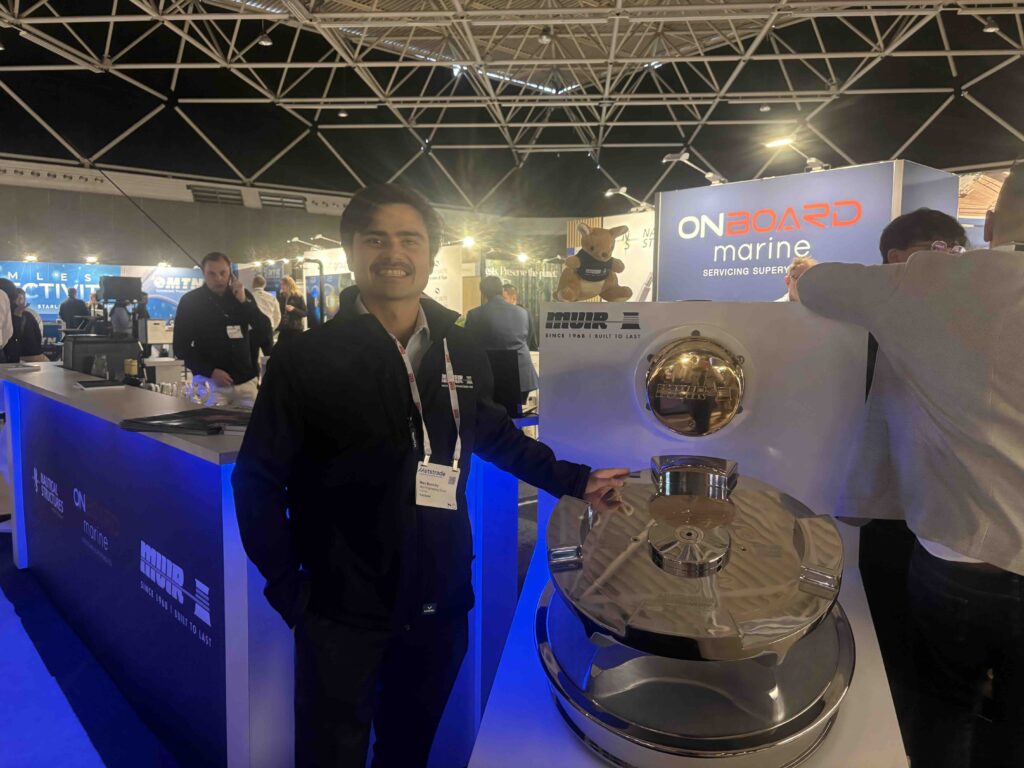
“The core philosophy when engineering our braking mechanisms for windlasses is inherently safe design,” says Muir Anchoring Systems general manager Max Buckley. “These two systems, the windlass and chain stopper, are handling the dynamic and static management of the anchor and rode. Every component within these systems, from the smallest grub screw to the largest casting, must be meticulously designed, manufactured, and tested with these demanding operational loads, with the safety of everyone onboard firmly in mind.”
Potential risks and failure modes
The consequences of system failures in conventional windlass brake designs can be serious. Any uncontrolled fall of the ground tackle can lead to extremely high windlass rotational speeds and the violent discharge of the ship’s chain, creating significant fire and projectile risks for any personnel in the vicinity.
Buckley continues: “The forces are substantial. A Muir 32mm stud link chain brake system, for example, is designed to hold around 40 tonnes, and the associated chain stopper around 70 tonnes.”
According to Muir, conventional systems observed by them are often single point of failure (SPOF) systems. In engineering design, this refers to systems where there is a critical weakness usually associated with a single component. If it fails, the result is the catastrophic failure of the entire system. In the case of a braking system, this is usually a single bolt or fastening system. If undone or if failure occurs, it means the brake shaft cannot be tightened, leaving the brake band inoperable.
Buckley says: “While regular maintenance and training can reduce the risk of these failures, at Muir, we believe that designing and manufacturing redundant braking systems is a more ‘foolproof’ approach to a safety critical system.
“In conventional band brake designs, we see a few primary areas of concern. Firstly, if the brake band actuation system – that’s the mechanism allowing the operator to clamp the band around the drum – fails, it can lead to uncontrolled freefall. Secondly, there is failure of the brake band retainer system, which is what transfers the torsional load from the brake band to the ship’s structure to arrest the anchor’s fall. Thirdly, there’s the failure of the wear interface between the brake band and drum.”
To demonstrate smooth, controlled operation, Muir’s partners TBS Marine, in Italy, produced a video highlighting brake handling on a Muir VRC15000.
Primary design goals in braking mechanisms
Whilst effective maintenance regimes can mitigate wear interface risks, failures in the actuation and retainer systems require a more fundamental engineering solution.
“For our mega-winch projects, for VRC6000s and larger, the Muir proprietary brake system is engineered from the ground up with risk mitigation at its heart,” says Buckley. “Our two main aims are to drastically reduce the risk of the actuation system failing or becoming disconnected from the brake band, and secondly, to reduce the risk of the retainer system failing or disconnecting from the base assembly, which ultimately transfers the load to the ship’s structure. Every component and interface is scrutinised to achieve these goals.”
Examples of the Muir design evolutions include the brake shaft and handwheel assembly. It features a captive handwheel held securely against a machined shoulder on a large diameter shaft. According to Muir, this means that even if the securing bolt and washer were somehow lost, the handwheel remains functional due to this machined shoulder.
Additionally, Muir uses bronze brake nuts with three levels of redundancy to prevent complete unwinding or loss of the brake shaft. These are installed captive within welded brake nut lugs and secured in place with self-aligning washers or stainless-steel circlips, (while other systems may rely on a single bolt to retain the brake nuts). The bronze material is chosen to reduce the risk of binding with the stainless-steel shaft, ensuring smooth actuation. The shaft is designed to ‘pull’ the free end of the band towards the fixed end, which is further fixed in place by a brake shaft retaining collar and a lock nut and washer on the end of the shaft.
Another area of focus is the brake band retainer or lug or block, which holds the brake in place and transfers the load to the windlass base. In Muir’s design, it is welded permanently to the brake band itself and is designed to ‘float’ within the peeler upright or the windlass base block – allowing the brake band to move freely in the vertical plane, self-aligning with the drum. This not only ensures even pressure and optimum braking efficiency but also prevents unintended constraints caused by misalignment or stress concentrations.

At the forefront of anchor system safety evolution
The trend in the maritime industry is towards systems that are powerful and durable, but also safer, simpler to maintain correctly and more intuitive for crews to operate under all conditions.
For Muir, Buckley says the manufacturer’s approach to the critical windlass braking mechanism and complete anchoring system is constant assessment of material advancements like new brake lining material, enhanced ergonomics for easier and safer operation, and smarter integration with overall vessel management systems.
He says: “While the foundational principles of robust mechanical engineering will always be central, we are constantly evaluating the evolution of safety features, driven by the non-negotiable priority of crew and vessel safety.”
Looking at the future of the anchoring sector and the continued quest for enhanced safety and reliability, Buckley believes discussions around design innovation to reduce the risk of failures and weaknesses are essential.
“We think it is critically important that the governing bodies such as the class societies are adding value by interrogating these issues during design reviews. Additionally, it is our job as a market leader to ensure discussions around these sorts of issues in design are brought to the attention of all of our peers – both clients and competitors – for it is the safety of the operators that should be paramount in all of our activities.
“We think that it is logical that the automation and reduction of operator interaction with windlasses, chain stoppers and anchoring systems is a critical step in our industry. Muir is working on several projects where this is central to our design philosophy, which we look forward to sharing in the coming months.”