GranOcean brings semi-custom power cats to Europe
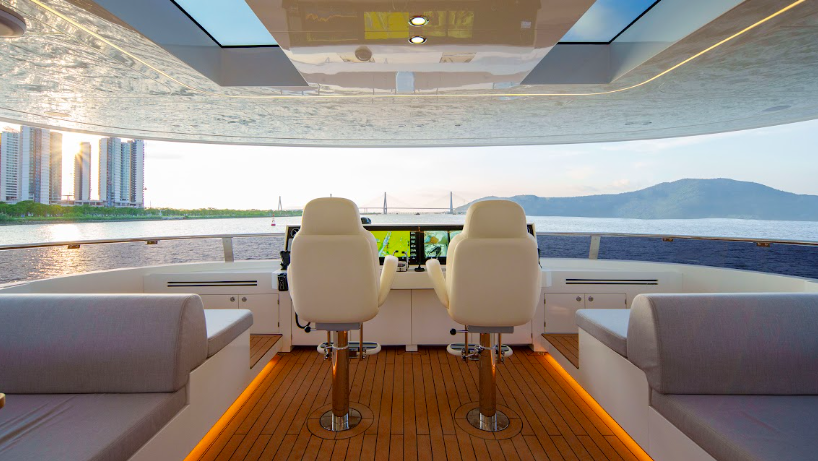 GranOcean started building Passage-Maker trawlers in 1998 before pivoting to custom catamarans in 2010
Power catamaran builder GranOcean is establishing a low-volume, semi-custom power-cat business model that combines Western-sourced equipment and engineering with Chinese production, while using a flexible platform to give owners a much greater degree of configuration than a conventional production boat.
Its W72 power catamaran received its European debut at Cannes Yachting Festival and represents the latest evolution of GranOcean’s semi-custom W-Series. Eric So, managing partner and lead designer, says it offers value rarely found in this market segment.
Jeremy Tutt, power division director for Catamaran Guru (the exclusive global sales dealer for GranOcean), adds GranOcean’s pricing is “at least 30 per cent lower” than comparable boats built in Italy.
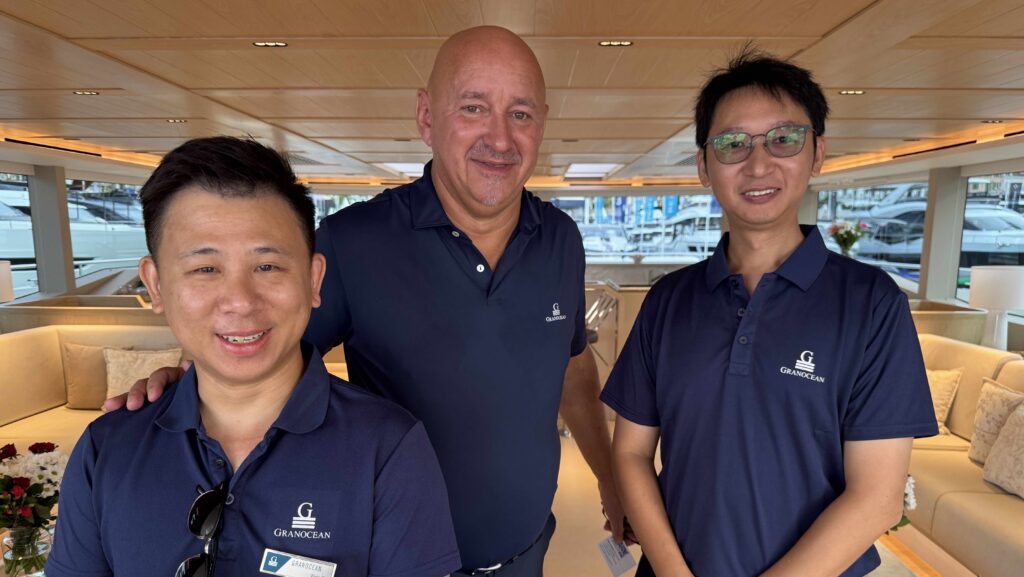
Western equipment, Chinese production
The company, based in the Chinese city of Zhuhai, sources components from Europe and the US, then brings them into China, where it equips and completes the boats before exporting them. Engine options include Cummins and Caterpillar, with Victron power-management systems. Solar equipment includes BougeRV, with standard solar panels used to make replacement easier.
The current high-specification boat is around $5m, with shipping costing approximately $200,000-$220,000. Tutt notes that even with shipping, it remains less expensive than competitors.
The company’s portfolio is structured across two distinct model lines:
W-Series – Semi-custom power catamarans from 60 to 72 feet, designed to maximise interior volume, cruising efficiency, stability and owner customisation.
X-Series – Fully custom power catamarans from 24 to 32 metres, developed around owners’ requirements, cruising plans and lifestyle ambitions.
From trawlers to semi-custom power cats
GranOcean started out building Passage-Maker trawlers (long-range monohulls) in 1998 before pivoting to custom catamaran requests in 2010. Its low-volume, high-specification approach has been a successful strategy so far.
“With the W60 series, we’re delivering hull number six now,” says Tutt, speaking to MIN from W72 hull number five during Cannes 2026.
As a semi-custom yard, customers specify three-, four- or five-cabin layouts, as well as linear galley or galley-down arrangements. Tutt says “layouts are a blank canvas for customers,” with options including moving the stairs and bulkheads.
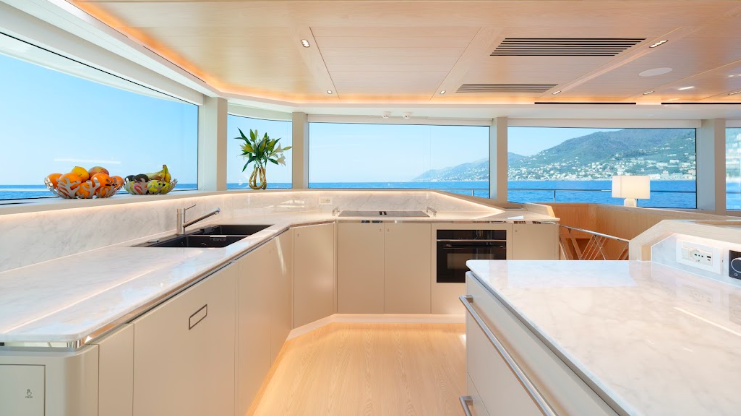
The underlying boat is essentially an adaptable platform, able to accommodate different propulsion, accommodation and layout decisions – but without making every boat effectively a new design.
Stimson Marine Design in New Zealand handles naval architecture, while Goetz handles structural engineering; both have America’s Cup experience. The boats use foam-core construction and vinyl ester resin throughout, including the hard tops, with no polyester used in the shipyard.
The offshore Category 0 hull’s shape allows the accommodation to extend further down into the hull.
Tutt says W72 hull five is fitted with Cummins 550 engines and is described as comfortable at around 11.5 knots, with a top speed of 16-17 knots depending on weight. The same hull has also been delivered with Caterpillar C18 engines, reaching 27 knots. A trial in two-metre waves and 30-knot winds recorded 26.5 knots. He notes that the boat remained intact during the test, with the ceiling panels still in place afterwards.
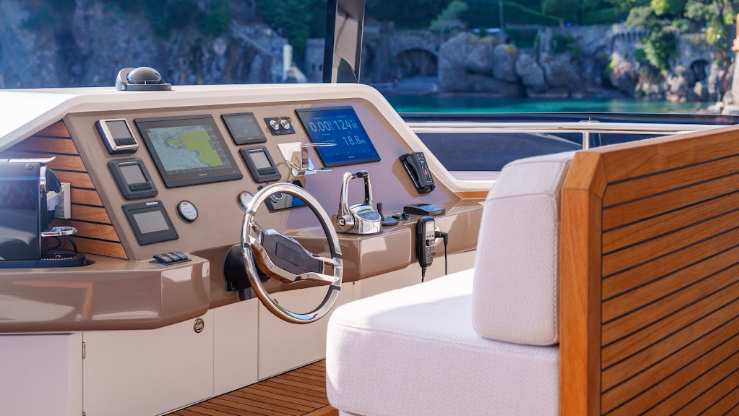
X-Series expands GranOcean’s ambitions
Other models are also happening, including the X series explorer range, with an X32 due for delivery in the next few months (details are available on the company’s website). It’s been in build for about four years for an existing customer. (The main deck has a central glazed staircase with crystal at the top, crew accommodation is in one hull, and guest accommodation in the other.)
The X-Series shows the yard’s ambition about moving beyond the 60-72ft semi-custom range into much larger, fully custom projects.
It’s 105 feet long, with a 40-foot beam, featuring Volvo engines and a 5,000 nautical mile range. It comes with a “huge” solar array, tender garages on both sides of the boat, and an owner’s suite on the top deck.
The owners “are going to start in Southeast Asia and then go on a global navigation with the boat,” says Tutt. “A lot of the shipyards claim to have a 30-metre on the drawing board. We say: ‘This is us finishing its build.’ That’s the reality.”
But GranOcean does have another on the drawing board. That’s a new model for an existing customer – a W86.
The US is a strong market for the company, while its boats are also suited to the Caribbean islands. It has boats in Australia and Singapore, including a 60 that was delivered into the water in Hong Kong and subsequently travelled under its own power to Sydney, a distance of about 4,500 nautical miles.
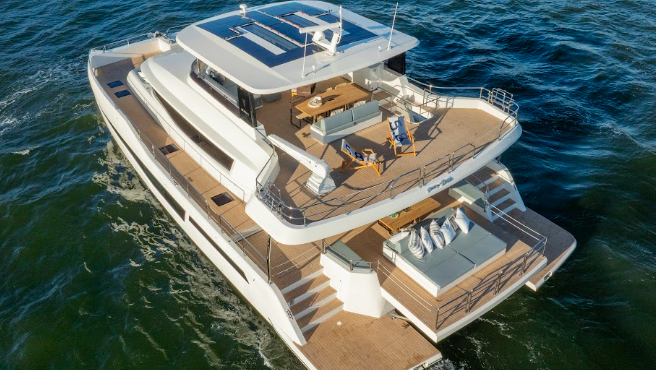
Onboard the W72
The W72 features a wide beam, flared hull design and high bridge deck clearance.
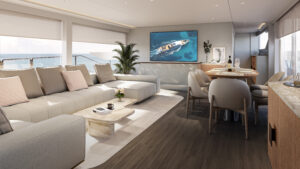
The yacht’s flybridge wings provide additional lounging space while also delivering practical benefits, including enhanced shade and protection for the cockpit below. Interior styling options developed by Dutch design studio Vripack offer owners a choice of Mediterranean, Scandinavian, Elegant Chic and Cosmopolitan themes.
Batteries, solar and air conditioning
GranOcean says it does not simply specify a larger battery bank or solar array by default. Instead, it says the electrical system is developed around what the owner wants the boat to achieve.
The W72’s batteries are positioned along the centreline. The standard specification uses gel batteries, some solar and a Frigomar inverter system, which the company says can run the air conditioning overnight without starting a generator.
One previously delivered cat had a bank of 40 lithium batteries, Thermodynamic air conditioning and a large solar array, allowing it to run for 36 hours without starting the generator.
GranOcean offers teak as a standard decking option, but customers can also choose Marine Deck 2000, a cork product from Dutch Stazo Marine Equipment. It’s cooler underfoot than teak, easier to maintain and longer-lasting, explains Tutt, while remaining comfortable to walk on. Marine Deck 2000 is a closed-cell material, so spilt liquids do not permeate through the planks.