
Tanker suffered steering failure before capsizing New Orleans riverboat
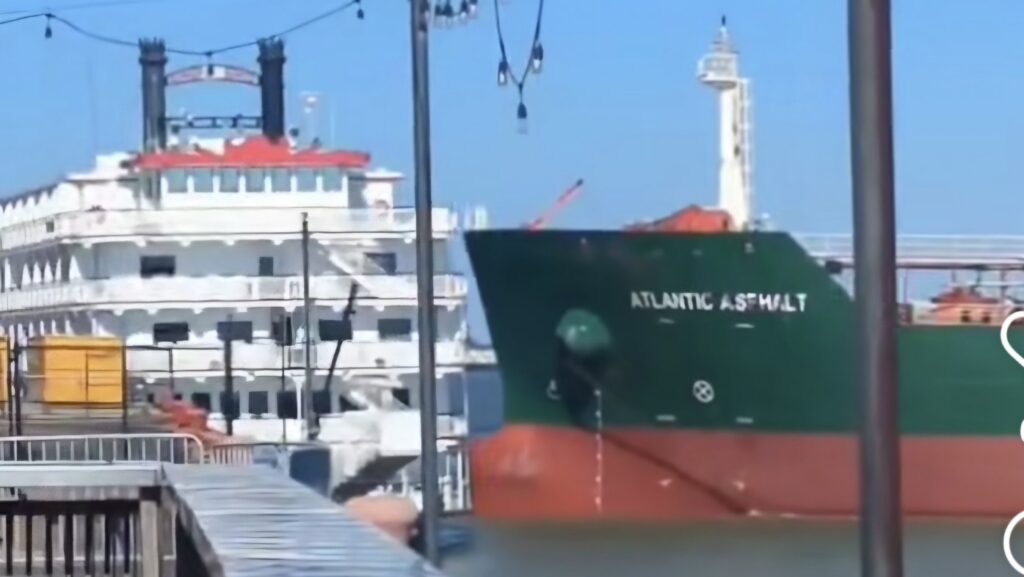 The tanker Atlantic Asphalt alongside American Heritage following the collision. Screengrab from video courtesy of @swellraiser/Instagram
A 520ft asphalt tanker struck a docked passenger riverboat on the Mississippi River in New Orleans on Friday, 13 November, causing the 300ft vessel to capsize and sending passengers and crew into the water.
Around 190 people were aboard the American Heritage when it was hit at Thalia Street Wharf, prompting a major rescue operation in which 32 people were taken to hospital, including two harbour police officers who entered the water during the rescue. All passengers and crew from both vessels were accounted for, with no fatalities reported.
The US National Transportation Safety Board (NTSB) has since identified a steering casualty aboard the tanker approximately two minutes before impact. Its preliminary review of the vessel’s voyage data recorder indicates that the rudder remained turned to starboard, causing the tanker to veer towards the east bank of the Mississippi River, where it struck the American Heritage.
Voyage data recorder captures emergency response
Investigators recovered the tanker’s voyage data recorder (VDR) on Saturday, downloading more than nine hours of information. The recording includes bridge audio, rudder angle, propulsion performance, vessel speed, and other operational data.
According to NTSB senior marine accident investigator Bart Barnum, the audio contains sounds consistent with the tanker’s whistle, warnings and requests for assistance broadcast over the vessel’s marine radio, commands to deploy its anchors, and emergency ship-handling orders.
The NTSB has not yet established what caused the steering failure, or whether the tanker’s anchors were successfully deployed. Investigators are continuing to examine the recorder data and other electronic evidence, and plan to interview the tanker’s crew.
The agency expects to publish a preliminary report within approximately 30 days, although a full investigation could take considerably longer. It is also asking members of the public with photographs or video footage of the incident to submit material to investigators.
Rescue operation prevents fatalities
The American Heritage began taking on water following the impact and capsized approximately 22 minutes later, leaving the vessel partially submerged on its side in the river.
Around 190 people were aboard, comprising approximately 140 passengers and 50 crew members. The rescue operation involved the US Coast Guard, New Orleans Fire Department, Port of New Orleans Harbor Police, local police, emergency medical teams, and nearby vessels whose crews helped recover people from the water.
American Cruise Lines praised the response of the vessel’s captain and crew, saying all passengers and crew were safe and accounted for. The company said it was arranging flights and hotel accommodation for affected guests, as well as providing ongoing support.
The company has published an official statement on the incident.
Tanker operator confirms incident as allision
OSM Thome, which manages the Atlantic Asphalt, confirmed that the vessel was involved in an allision with the American Heritage on 13 November.
In a media statement, the company said the tanker’s master immediately reported the incident to the US Coast Guard, and confirmed that all 19 crew members were safe and accounted for.
The operator said the tanker had separated from the passenger vessel and was stable at anchor while damage assessments took place. It also confirmed that its emergency response team had been activated and that it was cooperating with local authorities.
The term allision is used to describe a moving vessel striking a stationary object or vessel, distinguishing the incident from a collision between two vessels underway.
Salvage operation and river restrictions
The tanker was subsequently towed away from the scene, while the American Heritage remains capsized and partially submerged in approximately 25ft of water. Authorities have warned that removing the passenger vessel could take several weeks.
The Coast Guard has been coordinating recovery operations, including the safe removal of fuel and other hazardous materials remaining aboard the riverboat. The vessel is reported to have been carrying approximately 16,000 gallons of fuel, raising concerns about potential pollution during salvage work.
The Mississippi River has reopened to commercial traffic under restrictions, with vessels required to transit the affected section one way at a time and observe a safety zone around the wreck.
The Port of New Orleans has also filed a federal lawsuit against the tanker’s owner, Nave Shipping SA, and manager OSM Thome, seeking at least $1m in damages. The claim relates to damage to the Thalia Street Terminal, alongside associated recovery and inspection costs. A federal judge has authorised the seizure of the tanker while the claim proceeds.
The incident brings renewed attention to the risks associated with vessel manoeuvring in busy commercial waterways, and the importance of steering reliability and emergency response procedures. The NTSB’s investigation will examine the circumstances leading to the steering casualty, the actions taken by the tanker’s crew, and the factors that enabled the passenger vessel to be evacuated without loss of life.










Leave a Reply