Belgian sailor completes 5,300km North Atlantic crossing in Mini 6.50
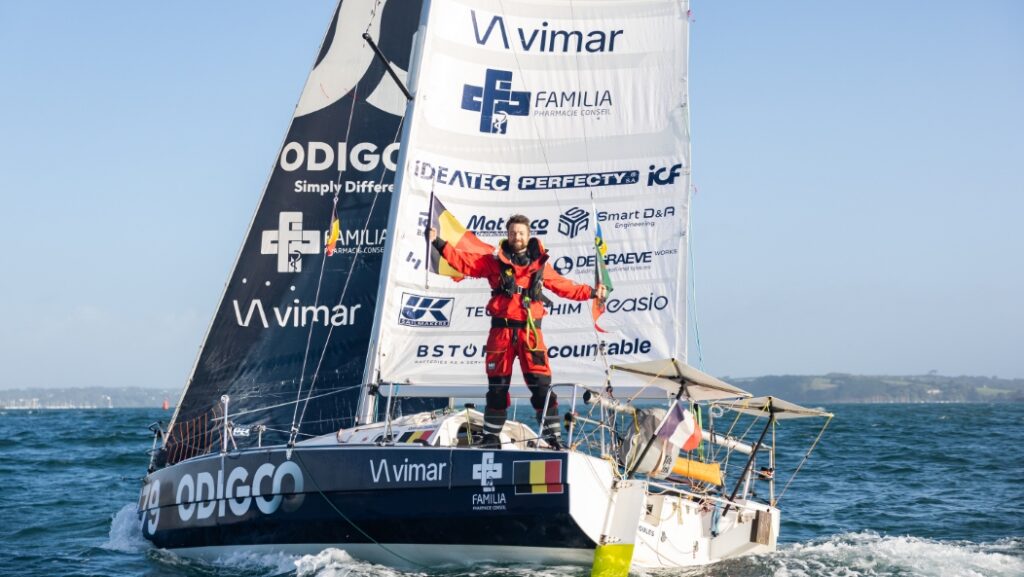 Quentin Debois completed the North Atlantic crossing in a Mini 6.50 after 20 days, 3 hours and 18 minutes at sea
Belgian sailor Quentin Debois has completed a solo 5,300km crossing of the North Atlantic from New York to England aboard a Mini 6.50. He arrived at Lizard Point in England on Wednesday 30 September 2026 at 3h11 22 sec UTC, completing the crossing in 20 days, 3 hours, 18 minutes and 40 seconds.
Debois is the third sailor to complete a west-to-east North Atlantic crossing on a Mini 6.50. David Allamelou of France completed the crossing in 2018, followed by Jay Thompson of the US in 2023. Olivier Jehl of France attempted the crossing in 2016, but his Mini 6.50 sank off Newfoundland.
Debois set a new personal speed record during the crossing and remained ahead of the predicted route for much of the passage. However, the weather prevented him from beating Thompson’s benchmark time of 17 days, 9 hours and 57 minutes.
Three areas of light winds and two severe low-pressure systems forced Debois to deviate from a direct route to England. The resulting detours extended the passage, leaving him with a finishing time of 20 days, 3 hours, 18 minutes and 40 seconds.
“I knew this record would be very difficult to break,” says Debois. “Jay Thompson had set the bar very high. The North Atlantic is a complex playground, dominated by low-pressure systems and weather conditions that can be harsh. Throughout the Transatlantic race, I stayed in the race, focused and determined, to achieve the best possible time. There was no question of letting up until I crossed the finish line!”
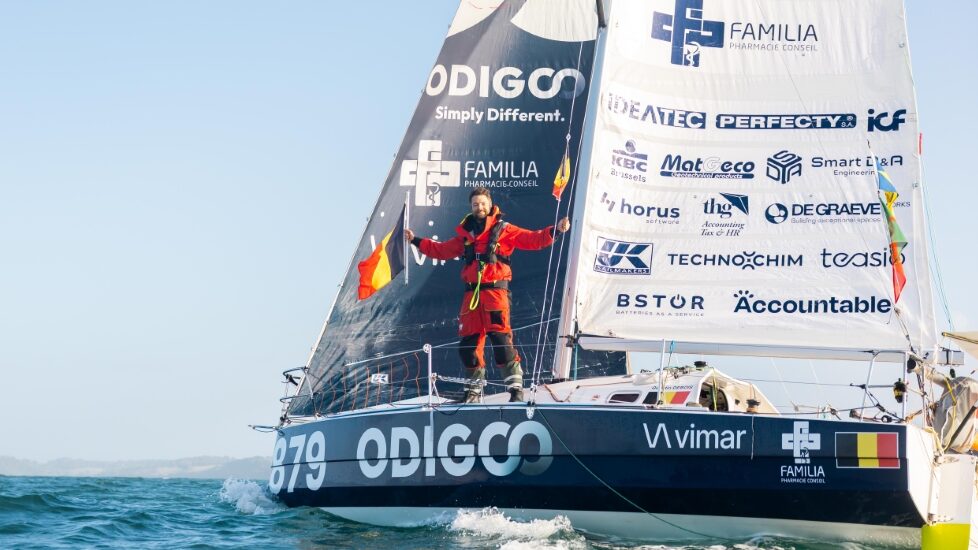
Debois continues: “Of course, it’s disappointing not to have broken that record. After months of preparation, anticipation, and hard work on this transatlantic race, I was dreaming of a victory. But I knew that attempting this record involved a significant amount of uncertainty and factors beyond my control. The boat performed flawlessly, and I gave it my all, but the weather wasn’t on my side. I’m focusing on the positives from this adventure: this transatlantic race was my best in terms of average speeds and performance in five years of offshore racing.
“Crossing the North Atlantic in a Mini 6.50 is an accomplishment in itself, and I’m very proud of the work we accomplished with the team.”
He confirmed that the campaign will now focus on a planned Vendée Globe entry in 2028.
“I’m very happy to have set a world record for the east-to-west Atlantic crossing this year – for Belgium, for my partners, and for my team. I’d like to thank them wholeheartedly for their support at every stage of this adventure. Without them, none of this would be possible.
“Now, together with the team, we’re going to focus 100 per cent on what’s next. Our next challenge will be to compete in the 2028 Vendée Globe. The journey to get there will be long, but we’re approaching it with tremendous determination. The first step will be to bring together partners who will join us on this adventure.”
Weather forces route changes
Basile Rochut, Debois’s route planner, explains that the Mini 6.50 encountered conditions that required several changes to the planned route.
“Quentin has just navigated conditions that very few Mini 6.50s have ever faced. Even in 4.5-metre waves, Quentin would tell me, ‘We’re getting through this, let’s keep going.’ He really fought until the very end to achieve the minimum time.
“We had no luck with the weather; conditions deteriorated very quickly. Starting in the first week, the three expected areas of light winds turned out to be much larger and longerlasting than anticipated. They cost us about twenty hours. The following week, the two forecasted low-pressure systems turned out to be more intense and were positioned further south. Quentin had to sail southeast to bypass areas where the waves were over 5 metres high – above 4.5 metres, the boat risks capsizing. These detours forced Quentin to take a longer route.
When the team assessed the weather during the weekend of 19–20 September, forecasts showed gusts of nearly 40 knots, with conditions expected to become more favourable towards the end of the race. This gave Debois an opportunity to recover some of the time lost earlier in the crossing.
The weather subsequently deteriorated again. Waves of more than 7m were predicted along the direct route, forcing Debois to head south to avoid them.
“In the end, conditions deteriorated again, with waves over 7 metres predicted along the direct route, forcing Quentin to head south to avoid them. The record was no longer within our reach. This really had nothing to do with a lack of performance on the part of the boat or the sailor, but rather with the unpredictable and highly variable weather conditions that forced Quentin to take a longer route.”
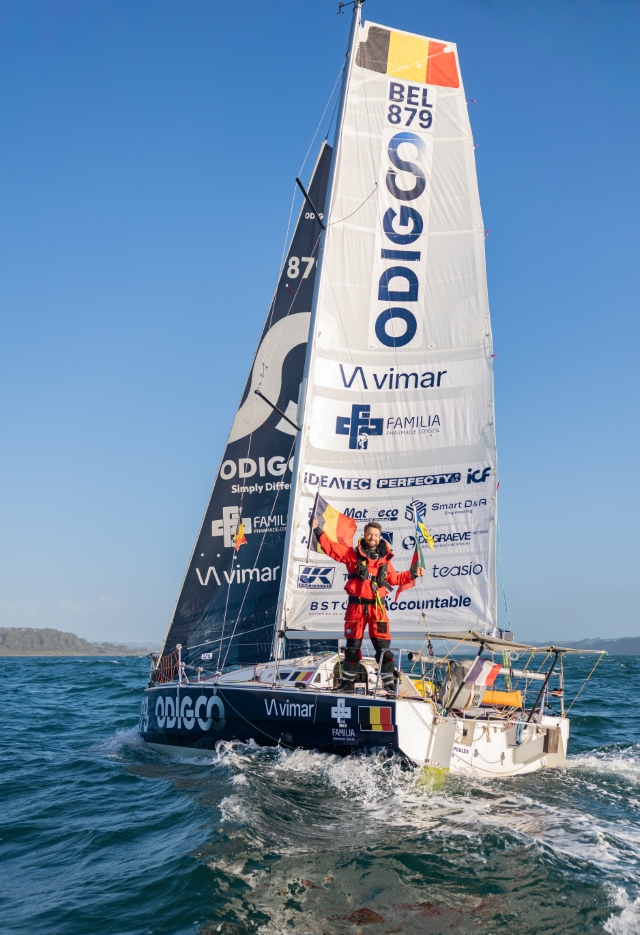
Rochut continues: “Quentin has the perfect profile for breaking records – he never gives up! Mentally, he’s as solid as a rock – persevering and patient. He capitalises on every small opportunity to go faster, gain an edge on the route, and move closer to the record. During the Transatlantique, he told me, ‘I’m kicking the door open to keep it open as long as possible.’
“Every time he lost a little time, he’d make it up. He never showed any sign of losing motivation, even in the toughest conditions. He never gave up; his competitive spirit always prevailed.”
Denis Van Weynbergh, Debois’s team manager for the 2028 Vendée Globe, explains that the crossing involved severe weather and equipment failures that required repairs during the passage.
“What Quentin has just accomplished is a remarkable feat. Few sailors – even the big names – would be capable of taking on this kind of challenge; it’s truly impressive! It takes a great deal of daring, courage, and self-sacrifice to tackle this kind of record. Boldness, because you have to dare to embark on this kind of project. Courage, because he’s completely alone at sea. A great deal of self-sacrifice, because there are always plenty of problems during the crossing. Quentin had to deal with severe weather and equipment failures. He had to make repairs, cope with the challenges, and constantly give it his all. It paid off.
“Even if he didn’t set the record, it doesn’t matter. We knew the window of opportunity was very narrow. You never know at the start if everything will fall into place over more than two weeks. In any case, his performance commands respect.”
Equipment failures during the crossing
Debois encounters two equipment-related incidents during the passage. On the first night, the boat struck an unidentified object, which damaged the port rudder. He replaced the rudder with a spare carried on board.
On 25 September, the tiller came loose from its shaft after five of the six screws securing it had broken. The incident also left the main autopilot unusable. Debois stopped the boat to carry out the repair before continuing several hours later.
“This is just the beginning, and more challenges await my team and me,” he says. We’re now focusing all our efforts on finding partners so we can be at the starting line of the next Vendée Globe in November 2028.”