Royal Navy USV crashing into yacht raises questions over autonomous vessels in busy harbour
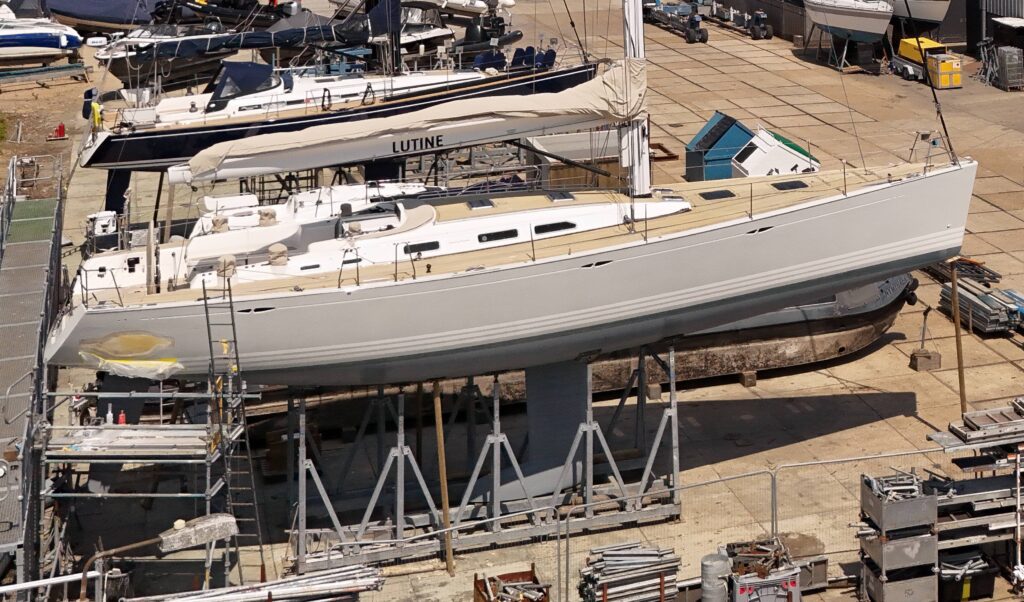 Lutine has repairs visible on the stern end of starboard side. Image courtesy of Simon Czapp, Solent News
An investigation is under way after a Royal Navy uncrewed surface vessel (USV) collided with Lutine, a 55-foot X-55 racing yacht owned and operated by Lloyd’s Yacht Club. According to the Royal Navy, the incident involved a Rattler craft and occurred during a ‘controlled training exercise’ within Portsmouth Harbour.
The collision draws attention to a programme that most recreational boaters will never have heard of. The Rattler uncrewed surface vessels are designed to test the future of the UK’s autonomous naval operations – but they are sharing one of the UK’s busiest waterways with ferries, commercial traffic and leisure craft.
An anonymous source quoted by The Sun claimed the drone “went rogue” earlier this month, before striking Lutine, which the source says was under sail and had right of way at the time.
Seemingly both vessels were damaged.
LLoyds Yacht Club makes brief statement
Lutine later entered dry dock at Hamble Point Marina to repair a gouge to its starboard stern. Guy Williams, commodore of Lloyd’s Yacht Club, confirmed the incident but declined to comment further, saying: “We can confirm the incident occurred but have nothing else to add.”
More significantly, the incident has focused attention on how autonomous vessels are operated safely in one of the UK’s busiest mixed-use harbours. Portsmouth Harbour handles naval vessels, ferries, commercial shipping and recreational craft, while King’s Harbour Master Portsmouth requires Rattler trials to comply with the International Regulations for Preventing Collisions at Sea (COLREGs), maintain a minimum separation from other traffic where possible, and modify or abort trials if a close-quarters situation develops.
Royal Navy investigates
The Royal Navy has confirmed it is investigating the incident. Despite the publication of the KHM notices, several aspects of the programme remain unclear following the collision with Lutine. The Royal Navy has not identified whether the Rattler was operating autonomously or under direct remote control at the time, whether the accompanying safety vessel intervened before the collision, or whether the incident has led to any changes to operating procedures or the programme’s safety case. Those questions remain central to the Royal Navy’s ongoing investigation.
In response to the questions above, and more, a Royal Navy spokesperson told MIN: “We are investigating an incident which occurred between a Royal Navy Rattler craft and a civilian yacht during a controlled training exercise in an area within Portsmouth Harbour. Both vessels have subsequently returned to the sea.” The navy also says that both vessels sustained minor damage and have subsequently returned to the sea and an investigation into the full circumstances of the incident is ongoing.
The Sun also reported that a Gosport ferry and a tug had previously been forced to take evasive action.
Rattler programme in Portsmouth Harbour and wider area
The Rattler programme forms part of the navy’s wider ambition to develop a ‘hybrid’ fleet, in which conventional warships operate alongside autonomous surface vessels, underwater systems and aircraft. The programme is intended to test both the technology and operating concepts that could shape future naval operations.
Developed for the Royal Navy’s Fleet Experimentation Squadron, the programme uses rigid inflatable boat-based uncrewed surface vessels built by SYOS Aerospace, which has its maritime headquarters in Fareham. According to the Royal Navy, the custom-built, fully uncrewed vessels were taken from concept to delivery ‘in a matter of weeks’, with training and initial sea trials beginning shortly afterwards.
One concept being explored is the deployment of multiple USVs operating together in coordinated ‘wolf packs’ to support crewed warships during future operations.
Programme extended from initial trial period
Official Local Notices to Mariners issued by King’s Harbour Master (KHM) Portsmouth show the programme has continued beyond its initial trial period. The notices identify seven craft operating under the AIS callsigns Rattler 1 through Rattler 7, with trials and training taking place in Portsmouth Harbour, Sandown Bay and Ryde Middle.
Rather than operating independently, the notices state the vessels are remotely controlled from a Remote Operating Centre (ROC) and are accompanied throughout exercises by a dedicated safety vessel. Depending on the trial, this may be a P2000 patrol vessel, PAC 24 RHIB or VAHANA workboat, with its crew responsible for intervening should any safety issues arise.
KHM notices also require the USVs to maintain a minimum separation of 200 metres from other craft where possible. Operations may take place by day or night.
Successive KHM notices covering 2025 and 2026 indicate that the Rattler programme has become an ongoing element of the Royal Navy’s experimentation and training activity in the Portsmouth area. Unlike many autonomous vessel trials conducted on restricted ranges, the Rattler craft operate within one of the UK’s busiest mixed-use waterways under KHM regulation, sharing the harbour with many independent and commercial vessels during authorised exercises.
Lutine name carries weight
The yacht’s name carries a long association with Lloyd’s of London.
Lloyd’s Yacht Club has traditionally named its flagship yacht Lutine after HMS Lutine, the Royal Navy frigate that sank off the Dutch coast in 1799 while carrying a cargo insured by Lloyd’s. Although much of the treasure was never recovered, the ship’s bell was salvaged decades later and has hung at Lloyd’s ever since as one of the insurance market’s best-known symbols.
For many years, the Lutine Bell was rung once to announce the loss of a ship and twice to signal that a vessel previously feared missing had arrived safely, ensuring news reached the underwriting room simultaneously. Today, the bell is preserved largely for ceremonial occasions, but it remains a powerful reminder of Lloyd’s maritime heritage.
This article was amended on 26 June at 13:16 to include the response from the Royal Navy to MIN.







Doubles up as a torpedo 😂
It’s interesting to consider that while settling the insurance claim might be straightforward, the question of liability becomes complex in the event of a fatality. Who would be held accountable and face prosecution in such a scenario?