Unmanned sea drone saves downed Apache crew in first publicly confirmed rescue mission of this type
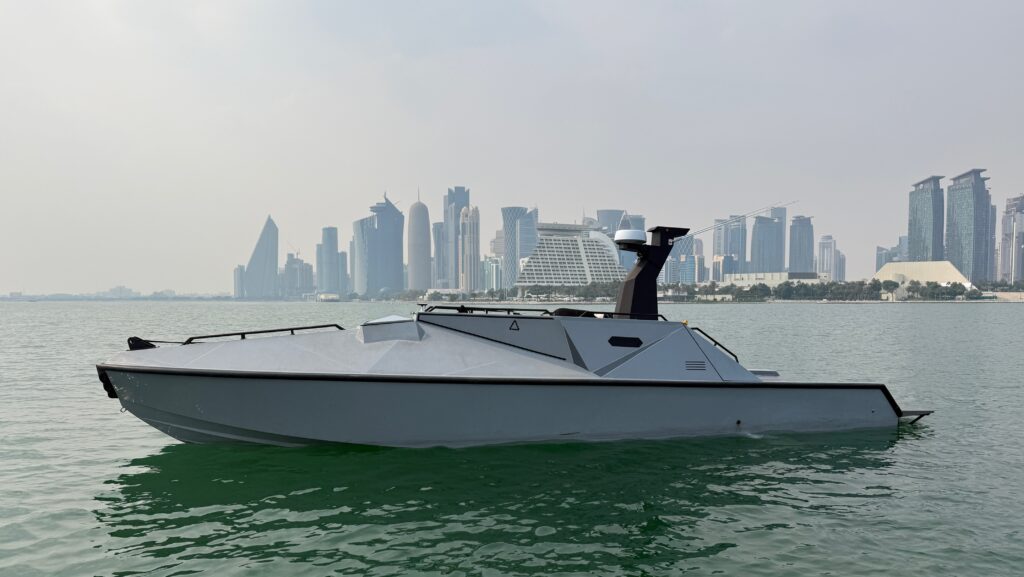
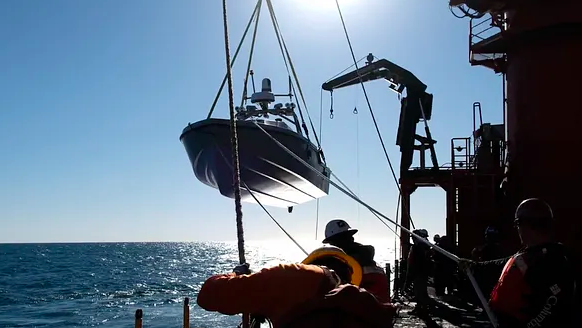 Saronic Corsair being launched at sea
Two members of a US Army helicopter that crashed near the Strait of Hormuz on Monday were rescued by a US Navy sea drone.
This is the first time the US military has publicly confirmed that an unmanned drone was used in such an operation.
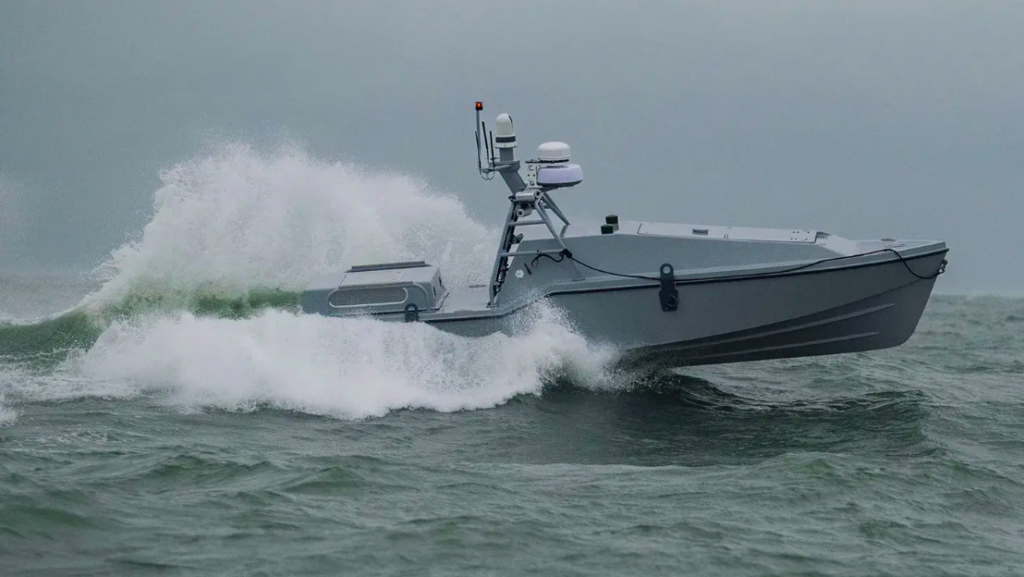
The rescue craft’s been officially identified as a Saronic Corsair, a 24-foot autonomous surface vessel. The drone is part of the US military’s expansion of unmanned vehicles. (According to the BBC, the US Navy awarded the Texas-based defence technology firm a $392 million production contract for its Corsairs late last year).
US Central Command (Centcom) says the two “soldiers were safely rescued within approximately two hours and are in stable condition” after their AH-64 Apache helicopter went down “near the coast of Oman while patrolling regional waters”.
Seemingly the men clambered onto the Corsair and were taken to a different vessel before being airlifted to shore in a helicopter. The initial incident occurred at 3.30 am (local time).
Corsair is an Autonomous Surface Vessel (ASV) capable of carrying up to 1,000 lbs over 1,000 NM with speeds of 35+ kts. It’s marketed as being ready to deliver ‘multi-mission capabilities rapidly and at scale around the world’.
The company also makes Mirage. That’s a 52-feet ASV with 2,500 NM of range and 3,500 lbs of payload capacity. Mirage serves as a ‘force multiplier’ for manned and unmanned teams.
Then there’s Marauder, which comes in at 180-feet. That’s designed to deliver ‘significant capabilities’. More details can be found on the company’s website.
Task Force 59’s growing role in unmanned operations
The uncrewed surface drone was operated by Task Force 59, says US Navy Captain Tim Hawkins.
Based in Bahrain, the task force focuses on “the operational deployment of unmanned systems teamed with manned operators to bolster maritime security across the Middle East region”.
Hawkins says the task force began fielding drones in the Middle East in late March.
The future of ASVs includes loitering
Saronic’s recently been testing Corsair. In an exercise, a fleet of eight Corsairs were sent to operate more than 70 nautical miles offshore. Autonomous missions were controlled remotely. To push the systems, the team conducted a range of missions, including more than 30 autonomous harbour transits, multiple long-distance endurance runs and continuous loiter operations.
The Corsair fleet logged over 4,500 nautical miles. It operated day and night across multiple sea states in conditions that, at times, could not have been endured by a human operator, says Saronic.
Part of the exercise was a continuous five-day autonomous loiter operation in which Corsair maintained its position and autonomously regulated power consumption, only engaging the engine when needed to maintain its station. Saronic says it has now demonstrated the ability to support more than 50 days of autonomous loiter, allowing operators to maintain persistent maritime awareness without the cost, risk or fatigue associated with crewed operations.
Saronic’s push to scale autonomous shipbuilding
In March this year, Saronic Technologies announced it had closed $1.75 billion in Series D funding to deliver autonomous platforms at scale across defence and commercial sectors.
“Over the past decades, the US has experienced a steady erosion of its ability to build ships and manufacture critical maritime infrastructure,” Dino Mavrookas, co-founder and CEO of Saronic said at the time.
“We are confronting this challenge with a fundamentally new model of American shipbuilding, one that integrates first-principles engineering, advanced manufacturing and software-defined production to deliver autonomous vessels with unprecedented speed, precision and scale.
“The new capital will accelerate Saronic’s ability to bring that model to life, generate entirely new classes of autonomous ships and maritime capabilities, and scale US shipbuilding capacity on a timeline not seen since World War II.”
Lloyd’s Register partnership targets regulatory progress
That news was followed in May with Saronic announcing a strategic partnership with Lloyd’s Register. The idea of the collaboration is to bring together Saronic’s expertise in autonomous maritime systems and Lloyd’s Register’s authority in maritime standards and certifications to advance the safe, scaled deployment of maritime autonomy in the United Kingdom, Europe and Australia.
As governments and regulators continue to define how autonomous vessels can be safely deployed and operated across maritime environments, close collaboration between commercial industry and assurance organisations is critical.
Saronic says, together with Lloyd’s Register, it will advance practical rules, technical standards and guidance for maritime autonomy, pursuing opportunities for coordinated technical engagement and collaboration with relevant regulators and authorities. The partnership aims to ensure that regulatory approaches keep pace with innovation while maintaining the highest standards of safety and operational reliability at sea.