Russian warship conducts ‘irresponsible’ live-fire exercise off UK coast
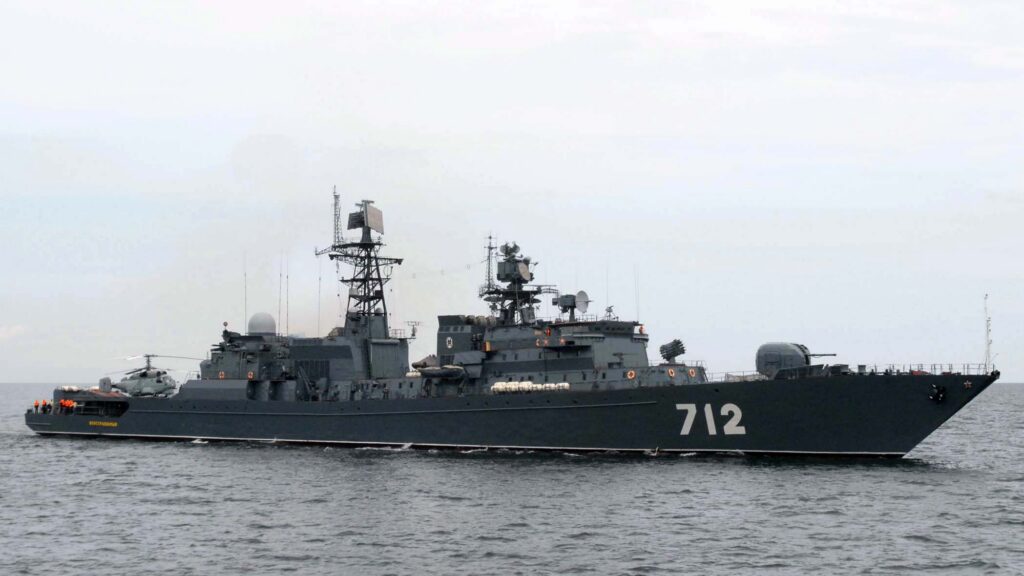 Neustrashimy is the lead ship of the Neustrashimy-class frigate of the Russian Navy’s Baltic Fleet
A Russian warship carried out a rare live-fire artillery exercise in international waters just 40 nautical miles (74km) south of the English city of Plymouth on Monday, while under close observation by the Royal Navy. The move has prompted criticism from newly appointed defence secretary, Wes Streeting.
The Russian frigate, Neustrashimy, informed the Royal Navy offshore patrol vessel HMS Tyne in advance that it intended to begin gunnery activity and requested that the British ship move to a safer position. HMS Tyne repositioned before the exercise, which lasted about 30 minutes. A French military aircraft also monitored the operation, with the BBC reporting that it made radio contact with the frigate to clarify its intentions.
A Ministry of Defence spokesperson says: “A Russian naval vessel shadowed by the Royal Navy conducted a live-fire weapons exercise in international waters approximately 40 nautical miles south of Plymouth yesterday.
“The Royal Navy monitored that exercise throughout, continues to track the vessel’s activity closely, and stands ready to protect UK national security.”
Speaking on his first full day as defence secretary, Streeting described the exercise as “performative and irresponsible”.
“It’s not the first time that Russia has behaved like this and frankly it’s the tip of the iceberg of the daily threats that this country faces and our allies face,” Streeting said.
“Russia should be in no doubt about the resolve of the new government and prime minister.”
The exercise took place a day after Andy Burnham became the latest prime minister. UK defence sources declined to comment on whether its timing was intended as a political signal from Russia.
Kremlin spokesperson Dmitry Peskov rejected any suggestion that the exercise was linked to the change of government.
“All [military] exercises and all actions undertaken by our warships are carried out in strict compliance with international and maritime law,” Peskov told BBC News.
“Therefore, there is no need to see any signals in this.”
However, he added that Burnham had sent signals to Russia, saying: “One of the first things the new British prime minister did as he took office was to declare his unconditional support for Ukraine and, accordingly, declare the UK’s intention to continue doing everything it possibly can to continue the war.”
The Neustrashimy has been operating around UK waters for several weeks, replacing the frigate Admiral Grigorovich after its extended deployment in the Channel and North Sea.
Russian naval activity around the UK has increased during 2026. Last month, the Royal Navy completed what it described as a three-month “unbroken watch” on Russian warships and accompanying vessels operating near UK waters. During that deployment, Admiral Grigorovich fired warning shots near the British yacht Bright Future south of the Isle of Wight, attracting global headlines. The couple on board said they had not been on a collision course with the warship.
According to the BBC, flight-tracking data showed several UK military aircraft operating in the area during Monday’s exercise, including two RAF Eurofighter Typhoons, a Voyager air-to-air refuelling aircraft and a Royal Navy Super Lynx helicopter. A French H160M Guépard helicopter also flew over the Channel, although it has not been confirmed whether it was the aircraft that contacted the Russian frigate.
Ship-tracking data indicated HMS Tyne remained near the exercise area for around two hours before returning to Plymouth. The patrol vessel has been shadowing Neustrashimy since at least 16 July, when both ships were observed in the North Sea off the Suffolk coast.
Retired Royal Navy commander Tom Sharpe said conducting a live-fire exercise so close to the south coast was unusual, despite being lawful in international waters.
“It is entirely allowable, but in my mind it is a signal,” he told the BBC.
Apart from the warning to HMS Tyne, the Russian vessel did not put any safety measures in place before firing a 100mm cannon, he said.
“One of the issues with firing a weapon of that calibre is that it can ricochet for miles, perhaps over ten miles beyond its intended landing point.
“You are in the busiest shipping lane in the world and who knows where it is going?”
Asked how the UK should respond, the retired commander said: “You could argue that this was them responding to us because we’ve upped the ante in the Channel; we boarded the [MV] Smyrtos, one of their dark fleet ships, which is now at anchor off the south coast.
“So we are in this tit-for-tat, which is kind of Cold War normality. We’ve just forgotten that this sort of stuff used to happen all the time, but we need to acknowledge that it is getting closer and closer to the UK.”








For up-to-date information on the wreck of the Liberty ship SS Richard Montgomery, and the dangers it presents to the people of Kent. See: The Richard Montgomery matter.
https://www.ssrichardmontgomery.com